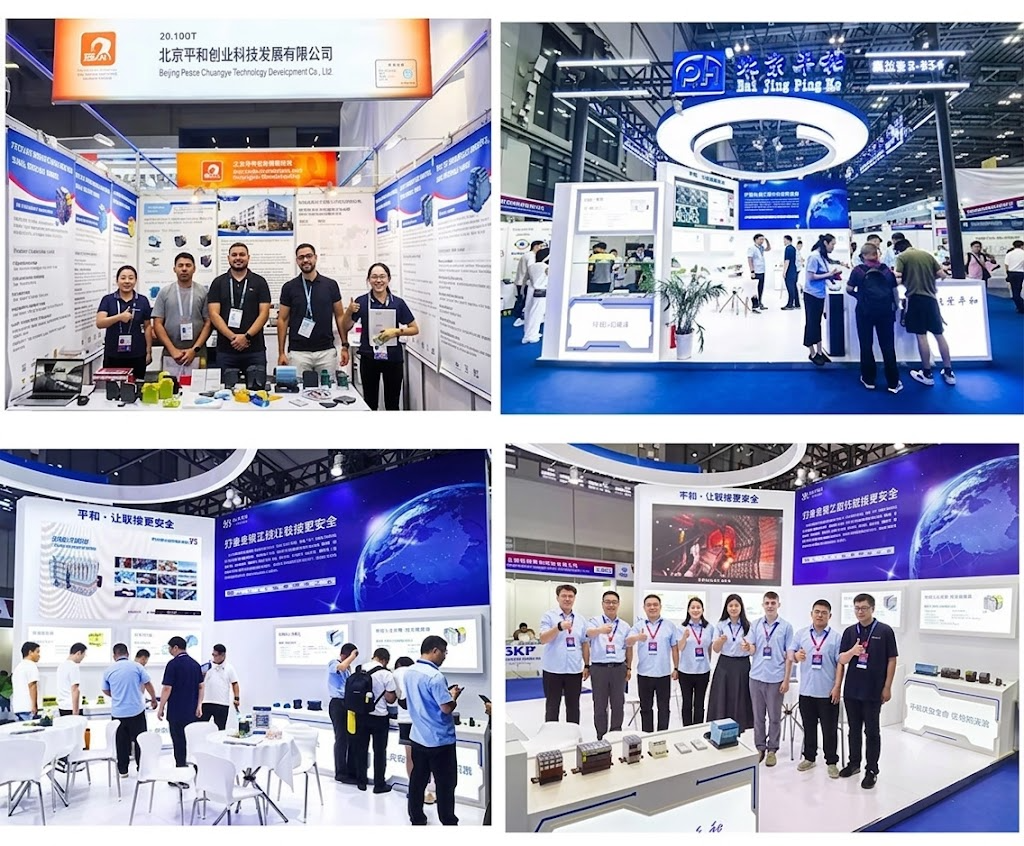
BEIJING, BEIJING, CHINA, August 19, 2026 /EINPresswire.com/ — Beijing Pinghe made its first appearance at CTEF 2026, the China International Chemical Technology and Equipment Exhibition held in Shanghai on June 9-11, 2026, presenting a four-part product combination built for chemical plant safety: isolated safety barriers, surge protective devices, safety relays, and isolated intelligent I/O modules. The combination covers the complete protection and control loop that a chemical park requires, from hazardous-area signal limiting at the field interface to emergency shutdown logic and centralized data acquisition. For chemical processing engineers and EPC contractors, the first appearance brought together in one booth the products that support emergency shutdown systems and process data collection as a closed loop, addressing the safety and reliability requirements that chemical production places on its instrumentation. The four-part combination also demonstrates how emergency shutdown and normal process data collection can share the same cabinet architecture, with the safety layer and the acquisition layer separated by design. The same architecture applies across the process units of a chemical park, where each unit needs the same protection sequence between field instruments and the control room.
Safety Barriers and Surge Protection for the Field Interface
The field interface of a chemical plant combines two protection needs. Isolated safety barriers limit the energy entering hazardous areas, keeping the signal path from igniting an explosive atmosphere while passing the process measurement. Surge protective devices at the cabinet entry absorb lightning-induced transients that would otherwise reach the loop electronics. The two product lines work as a matched pair: the surge protector clamps the overvoltage at the boundary, and the barrier isolates and conditions the signal behind it.
For chemical processing applications, the barrier range carries the certifications that hazardous-area work requires, and the same protection concept extends to the fire and gas loops that chemical plants install for process safety. The combination gives the control room a clean, protected signal path from the field transmitter to the DCS.
Safety Relays for Emergency Shutdown Systems
Safety relays form the logic layer of an emergency shutdown system. Unlike a general-purpose relay, a safety relay is designed with redundancy in the circuit, contact welding protection, and fail-safe behavior: when a fault occurs in the relay itself, the output must move to the safe state rather than hold its last position. This distinction is the core of safety relay design. Beijing Pinghe safety relays are organized into SIS system safety relays for safety instrumented functions and mechanical system safety relays for machine and process protection, covering the two roles that emergency shutdown logic requires. Both relay families share the same fail-safe design principles, so the shutdown logic is consistent whether it protects a process unit or a mechanical system.
For a chemical park, the emergency shutdown function depends on this fail-safe behavior. The safety relay receives the shutdown signal from the safety logic solver and drives the final elements to the safe position, and its redundant circuit design ensures that a single internal failure cannot defeat the shutdown path.
Intelligent I/O Modules for Data Acquisition
Closing the loop on the acquisition side, isolated intelligent I/O modules concentrate field signals into the control system with isolation between channels and the bus. The modules collect analog and digital inputs from the process area, isolate them from the control network, and pass the data to the DCS or PLC. For chemical processing, the isolation prevents ground loops between distributed field devices and the control system, which matters in plants where instruments are spread across large process units.
The combination of the four product lines supports the full instrumentation architecture of a chemical plant: barriers protect the hazardous-area signals, surge protectors shield the cabinet entry, safety relays execute the shutdown logic, and intelligent I/O modules concentrate the data. When all four come from one manufacturer, the terminal layouts, the documentation, and the quality system are consistent across the entire control cabinet. This consistency shortens the engineering time spent matching terminal layouts and certification records between different manufacturers, and it simplifies the spare parts inventory that maintenance teams must hold.
Chemical Industry Credentials
The same product combination, including isolated safety barriers, has been extensively applied in chemical plant automation projects, providing field experience that supports the CTEF presentation. Beijing Pinghe has been included in the Petrochemical Industry Instrument Catalog, and its participation in CTEF 2026 reflects the company’s strong focus on the chemical processing segment. To guarantee long-term operational integrity for international engineering projects, Beijing Pinghe supports this hardware portfolio with automated SMT manufacturing lines, rigorous multi-stage quality testing, and full component-level batch traceability. This industrialized quality control framework ensures that every module strictly aligns with global chemical safety standards, providing global plant operators with documented reliability. For buyers who visited the show, the product demonstrations provided a direct look at how the four-part combination is wired and configured for chemical applications. For process safety engineers, the demonstrations also showed how the safety relay layer interfaces with the barrier and I/O layers, providing a reference wiring model for chemical cabinet design.
Conclusion
Beijing Pinghe concluded a successful debut at CTEF 2026 with a four-part product combination covering hazardous-area barriers, surge protection, safety relays, and intelligent I/O modules, supporting the emergency shutdown and data acquisition needs of chemical processing. The safety relay range, with its redundant circuit design, contact welding protection, and fail-safe behavior, anchors the emergency shutdown layer, while the barrier, surge, and I/O lines complete the protection and acquisition loop. Founded in 2004 and exporting to over 40 countries and regions, Beijing Pinghe demonstrated its industrial signal interface expertise to the chemical sector at the Shanghai show.
More information regarding Beijing Pinghe safety barrier, surge protection, safety relay, and I/O module specifications is available at the official company website: https://www.beijingph.com/. Product-specific inquiries can be directed to the Beijing Pinghe sales team through the website.
Beijing Pinghe Chuangye Technology Development Co., Ltd.
Beijing Pinghe Chuangye Technology Development Co., Ltd.
+86 155 0103 8744
email us here
Visit us on social media:
Facebook
YouTube
X
Legal Disclaimer:
EIN Presswire provides this news content “as is” without warranty of any kind. We do not accept any responsibility or liability
for the accuracy, content, images, videos, licenses, completeness, legality, or reliability of the information contained in this
article. If you have any complaints or copyright issues related to this article, kindly contact the author above.

Media gallery