
Drill hole SC-26-16 intersects 451 Metres at 0.30% CuEq from top of bedrock including 101 Metres at 0.50% CuEq including 12 Metres at 1.70% CuEq
TORONTO, ON / ACCESS Newswire / September 3, 2026 / Sterling Metals Corp. (TSXV:SAG)(OTCQB:SAGGF) (“Sterling” or the “Company”) is pleased to report assay results from four drill holes, SC-26-14 through SC-26-17, at the MEPS Zone (“MEPS“), part of the Company’s ongoing 20,000 metre drill program at the Soo Copper Project (“Soo Copper” or the “Project“), near Batchewana Bay, Ontario. The results build on the strong mineralization reported in SC-26-13 (see press release dated August 10, 2026), demonstrating continuity of broad copper-molybdenum mineralization and higher-grade copper zones as drilling progresses east. Importantly, SC-26-16 intersected a granite porphyry stock at its shallowest depth to date and, for the first time, confirmed that the stock itself is mineralized, with elevated molybdenum and associated copper.
Highlights:
-
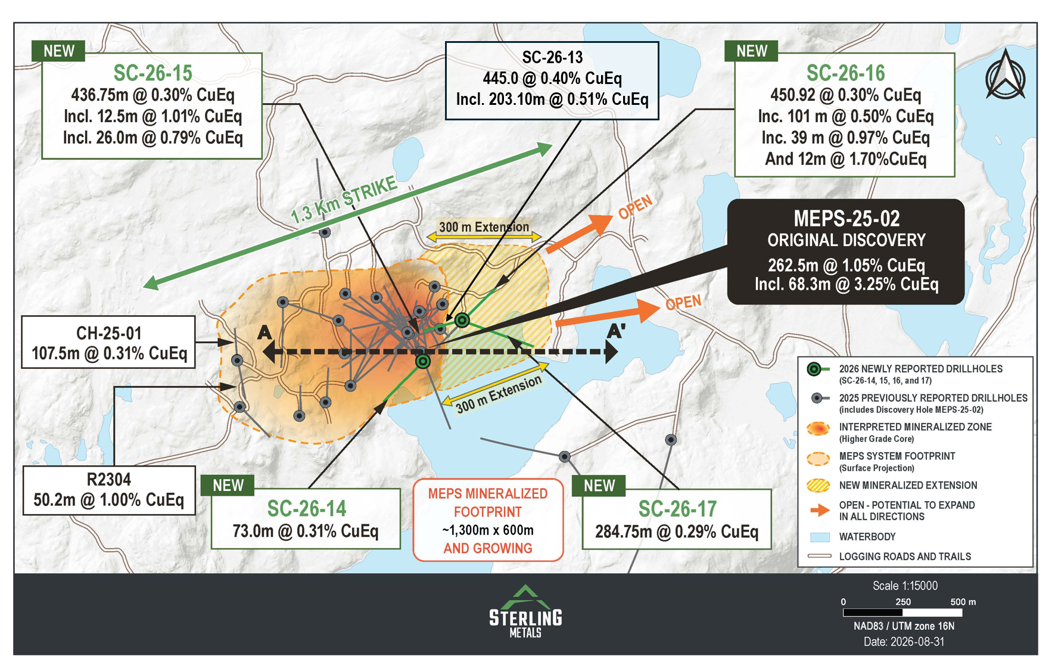
Strike of the MEPS discovery has increased by 300m now extending to over 1.3km highlighted by SC-26-16 intersecting 101m grading 0.5% CuEq including 12m of 1.7% CuEq within 450.92m of 0.30% CuEq from the top of bedrock.
-
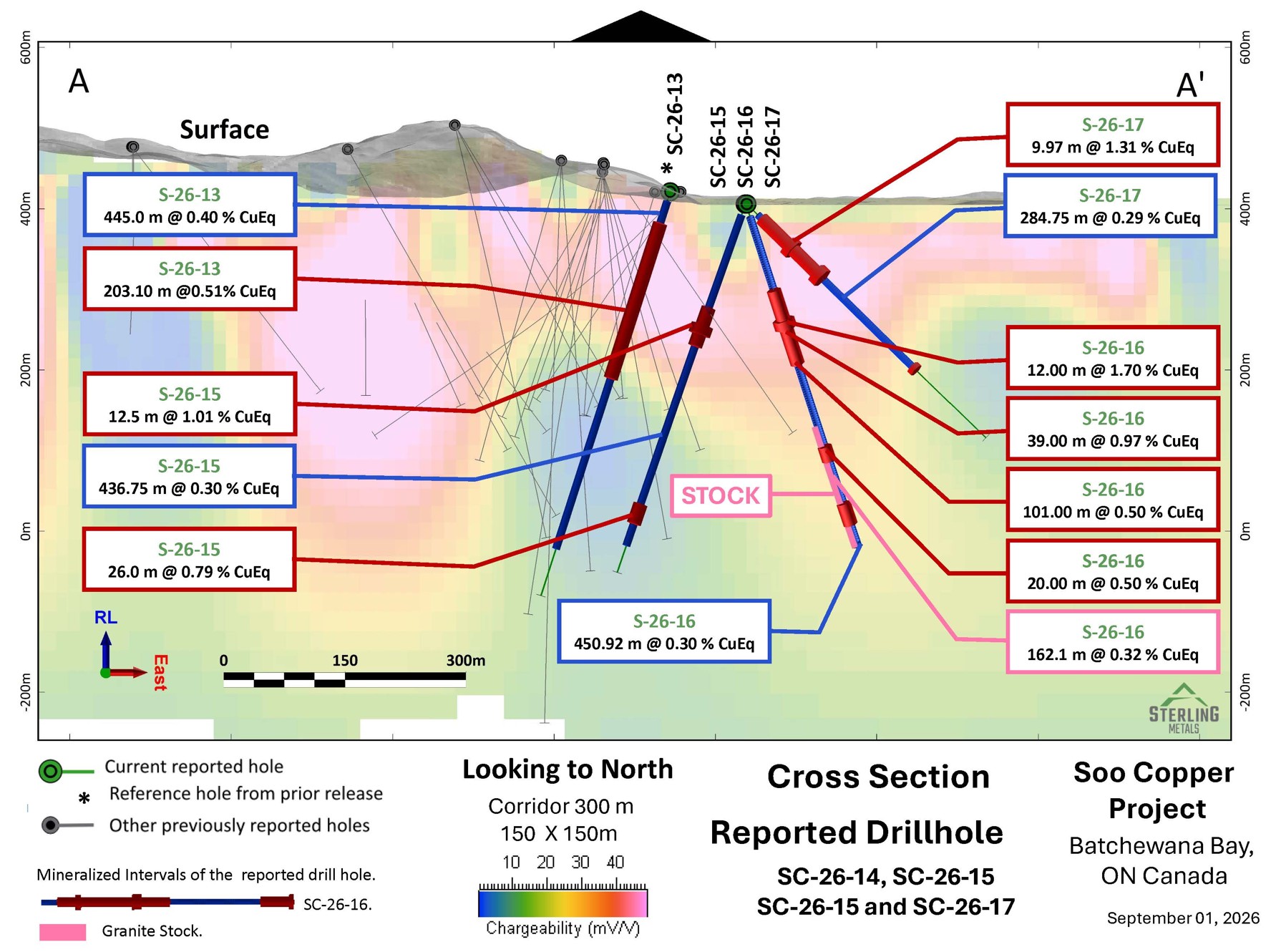
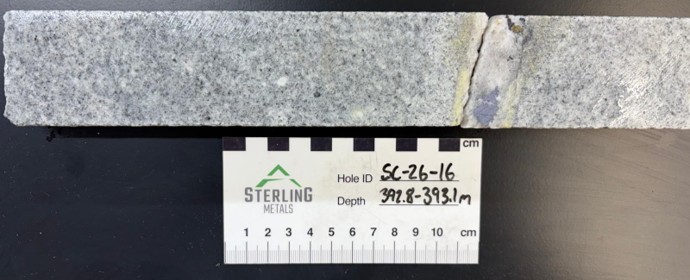
SC-26-16 intersected a granite porphyry stock at 301m downhole. The stock was associated with disseminated molybdenum, high grade molybdenum veining and associated copper grading 0.32% CuEq over 162m with the final 3m returning elevated molybdenum grades of 2,080ppm, 2,060ppm and 659ppm (copper equivalent grades of 1.16%, 1.07% and 0.35% CuEq, respectively).
-
Mineralized, molybdenum-rich intrusions are commonly associated with the central portions of porphyry systems, providing an important vector for ongoing drilling as Sterling continues to test a system that remains open to the east and at depth.
Jeremy Niemi, P.Geo., Senior Vice President, Exploration and Evaluation, commented, “Throughout the 2026 program, we have been systematically stepping outward from the core of the MEPS discovery looking for the boundaries of this potential deposit. Drilling has now outlined mineralization over approximately 1.3 kilometres of east-west strike, and holes SC-26-15, 16 and 17 have extended the eastern side of the system by 300 metres, while leaving it completely open in that direction. Importantly, SC-26-16 intersected the shallowest and most strongly mineralized granite porphyry stock we have seen to date, with persistent molybdenum mineralization and associated copper beginning at approximately 300 metres depth and extending through the entirety of the stock intersected in this drill hole. Given the common association of molybdenum with the central parts of porphyry systems, we believe this is an important geological vector and provides a compelling opportunity for continued expansion to the east.”
Technical Discussion
The MEPS porphyry copper system is characterized by broad, near-surface copper mineralization hosted predominantly in altered Neoarchean mafic volcanic rocks intruded by multiple phases of Mesoproterozoic felsic porphyry. Previous drilling has demonstrated that stronger copper grades commonly occur adjacent to early “GFP” felsic dykes and sills and associated magnetite-rich veining, while deeper portions of the system contain molybdenum-rich breccias and mineralized granite porphyry.
SC-26-14 was drilled southwest from the core of MEPS to fill a large gap between MEPS-25-01 and the main east-west mineralized trend. The hole was consistently mineralized and confirmed the upper GFP horizon, but it appears to have passed south of the emerging axis of stronger east-west copper mineralization. The hole adds mineralized volume in an area that remains important for follow-up and geological interpretation.
SC-26-15 was collared approximately 100m east of SC-26-13 and drilled west at a similar declination. The hole confirmed a continuation of the same broad mineralization style observed in SC-26-13, including GFP felsic sills with elevated copper mineralization and ribbon veins adjacent to the intrusive contacts. At depth, SC-26-15 intersected a molybdenum-rich zone from 396m to 422m grading 0.79% CuEq over 26m.
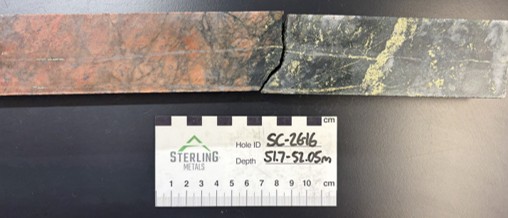
SC-26-16 was drilled east from the same pad as SC-26-15 and intersected broad mineralization from near surface to the end of the sampled interval. The near-surface portion of the hole intersected a GFP felsic sill with elevated copper mineralization and multiple ribbon veins near its upper and lower contacts. Farther downhole, SC-26-16 intersected the granite porphyry stock at its shallowest position encountered to date. Unlike other, deeper intercepts of the stock, this interval is consistently mineralized with elevated molybdenum and associated copper. The hole includes a broad molybdenum-rich interval within the granite stock and remains mineralized at depth. It is considered possible that this shallow, Mo-Cu mineralized body of granite porphyry is part of a cupola zone of the underlying stock, where more concentrated Cu-Mo mineralization is characteristically found in other porphyry systems.
SC-26-17 was drilled southeast from the same pad as SC-26-15 and SC-26-16, approximately 200m south of and above the granite porphyry stock intercepted in SC-26-16. The hole intersected broad copper-molybdenum mineralization, a narrow GFP felsic sill near 80m downhole and a notable high-grade molybdenite vein near 86m depth. Bornite with chalcopyrite was observed near the bottom of the hole. SC-26-17 did not intersect the granite porphyry stock.
Together, the four holes continue to define a broad mineralized footprint at MEPS and provide additional evidence that the copper-molybdenum system remains open to the east and at depth. Follow-up drilling will continue to test the geometry, continuity and grade distribution of the GFP-associated copper zones and the deeper mineralized intrusive and breccia domains.
Table 1. Significant Assay Intervals
|
Hole Number |
From |
To |
Length |
Cu % |
Mo ppm |
Au (g/t) |
Ag (g/t) |
CuEq % |
|
SC-26-14 |
29 |
102 |
73 |
0.28 |
5.32 |
0.01 |
1.00 |
0.31 |
|
SC-26-14 |
50 |
72 |
22 |
0.41 |
6.30 |
0.01 |
1.62 |
0.44 |
|
SC-26-15 |
14.25 |
451 |
436.75 |
0.15 |
225.36 |
0.02 |
1.61 |
0.30 |
|
SC-26-15 |
137 |
188 |
51 |
0.41 |
31.00 |
0.05 |
3.16 |
0.50 |
|
SC-26-15 |
160 |
172.5 |
12.5 |
0.83 |
32.42 |
0.13 |
5.12 |
1.01 |
|
SC-26-15 |
396 |
422 |
26 |
0.02 |
1472.13 |
0.01 |
0.69 |
0.79 |
|
SC-26-16 |
17.18 |
468.1 |
450.92 |
0.13 |
275.84 |
0.02 |
1.22 |
0.30 |
|
SC-26-16 |
117 |
218 |
101 |
0.35 |
154.41 |
0.05 |
2.96 |
0.50 |
|
SC-26-16 |
147 |
186 |
39 |
0.65 |
345.61 |
0.10 |
5.10 |
0.97 |
|
SC-26-16 |
157 |
169 |
12 |
1.32 |
110.50 |
0.23 |
10.84 |
1.70 |
|
SC-26-16 |
306.0 |
468.1 |
162.1 |
0.03 |
545.74 |
0.00 |
0.52 |
0.32 |
|
SC-26-16 |
330 |
350 |
20 |
0.02 |
922.65 |
0.00 |
0.56 |
0.50 |
|
SC-26-16 |
408 |
437.5 |
29.5 |
0.02 |
767.62 |
0.00 |
0.39 |
0.41 |
|
SC-26-17 |
19.75 |
304.5 |
284.75 |
0.19 |
116.79 |
0.03 |
1.23 |
0.29 |
|
SC-26-17 |
26.5 |
136 |
109.5 |
0.26 |
244.56 |
0.04 |
1.67 |
0.43 |
|
SC-26-17 |
74.53 |
84.5 |
9.97 |
0.41 |
1608.40 |
0.06 |
2.90 |
1.31 |
|
SC-26-17 |
124.8 |
136 |
11.2 |
0.46 |
391.03 |
0.03 |
2.25 |
0.71 |
|
SC-26-17 |
297.5 |
304.5 |
6.5 |
0.49 |
126.58 |
0.26 |
4.25 |
0.84 |
|
SC-26-17 |
69.8 |
84.5 |
14.7 |
0.35 |
1104.61 |
0.05 |
2.41 |
0.98 |
Intervals may not represent true widths, which are not yet known, and capping has not been applied to grades. Copper Equivalent (CuEq) for drill intersections is calculated based on a three-year trailing average for each commodity (2023, 2024 and 2025), which equates to US$4.18/lb Cu, US$2,600/oz Au, US$30.54/oz Ag and US$21.46/lb Mo, with 80% metallurgical recoveries assumed for all metals. The formula is: CuEq % = Cu % + (0.907 × Au g/t) + (0.0107 × Ag g/t) + (0.00051 × Mo ppm).
Table 2. Hole Locations, Directions and Final Depths
|
Hole number |
Easting |
Northing |
Elevation |
Depth |
Dip |
Azimuth |
|
SC-26-14 |
681072.00 |
5212429.00 |
449.00 |
408.00 |
-55.00 |
225.00 |
|
SC-26-15 |
681237.00 |
5212606.00 |
406.00 |
486.00 |
-72.00 |
255.00 |
|
SC-26-16 |
681238.00 |
5212603.00 |
406.00 |
468.10 |
-67.00 |
45.00 |
|
SC-26-17 |
681239.00 |
5212603.00 |
406.00 |
428.09 |
-45.00 |
110.00 |
Sampling Procedures – Quality Assurance/Quality Control
Analytical services were provided by Actlabs, which is an independent, CALA- and SCC-accredited analytical services firm registered to ISO 17025 and ISO 9001 standard. Drill core samples were logged and split in half with a diamond core saw. Half-core samples were securely stored at the core logging facility until being delivered to Actlabs Thunder Bay lab by commercial transport.
Samples were crushed (< 7 kg) up to 90% passing 2mm (10 mesh), riffle split to 250 g and pulverized by mild steel to 95% passing 105μm (150 mesh). Samples splits underwent a 4-acid near total digestion followed by a multi-element analysis, including base metals, using an ICP method for 35 elements.
Selected sample pulps were then analyzed for gold using a 30 g aliquot mixed with fire assay fluxes and Ag as a collector, placed in a fire clay crucible, gradually heated to 1060ºC for 60 min, and followed with an AA finish.
Laboratory QA/QC for the ICP analysis was 14% for each batch, including 5 method reagent blanks, 10 in-house controls, 10 samples duplicates, and 8 certified reference materials. An additional 13% QA/QC was performed as part of the instrumental analysis to ensure quality in the areas of instrumental drift. Laboratory quality control for the gold fire assay included two blanks per 42 samples, three sample duplicates and 2 certified reference materials, one high and one low (QC 7 out of 42 samples).
In-house QA/QC included the systematic insertion of blanks, duplicates, and certified reference materials (CRM).
Qualified Person
Jeremy Niemi, P.Geo., Senior Vice President, Exploration and Evaluation for Sterling Metals has reviewed and approved the technical information presented herein.
About the Soo Copper Project
The Soo Copper Project sits just 20 minutes off the Trans-Canada Highway, one hour north of Sault Ste. Marie, and 20km from rail and deep-water access. With near-surface copper-one of the most critical of all critical metals-alongside gold, and with the project now demonstrating both scale and grade, Sterling sees the potential for Soo Copper to become a nationally significant asset as Canada accelerates its efforts to secure strategic copper resources. Prime Minister Carney’s recent designation of copper as one of Canada’s first five strategic assets underscores the importance of this discovery and its potential to emerge as a key project of national interest.
About Sterling Metals
Sterling Metals is a mineral exploration company focused on large scale and high-grade Canadian exploration opportunities. The Company is advancing the 25,000-hectare Soo Copper Project in Ontario which has past production, and multiple breccia and porphyry targets strategically located near robust infrastructure and the 29,000-hectare Adeline Project in Labrador which covers an entire sediment-hosted copper belt with significant silver credits. Both opportunities have demonstrated potential for important new copper discoveries, underscoring Sterling’s commitment to pioneering exploration in mineral rich Canada.
Sterling Metals acknowledges that its exploration activities within the Soo Copper project are conducted on the traditional lands of the First Nations of the North Shore of Lake Superior. We recognize and respect the longstanding and diverse relationships Indigenous Peoples have with the land and are committed to engaging in a manner that is respectful, transparent, and inclusive.
For more information, please contact:
Sterling Metals Corp.
Mathew Wilson, CEO and Director
Tel: (416) 643-3887
Email: info@sterlingmetals.ca
Website: www.sterlingmetals.ca
Neither the TSX Venture Exchange nor its Regulation Services Provider (as that term is defined in the policies of the TSX Venture Exchange) accepts responsibility for the adequacy or accuracy of this release. This news release contains certain “forward-looking information” within the meaning of applicable securities laws. Forward looking information is frequently characterized by words such as “plan”, “expect”, “project”, “intend”, “believe”, “anticipate”, “estimate”, “may”, “will”, “would”, “potential”, “proposed” and other similar words, or statements that certain events or conditions “may” or “will” occur. These statements are only predictions. Forward-looking information is based on the opinions and estimates of management at the date the information is provided and is subject to a variety of risks and uncertainties and other factors that could cause actual events or results to differ materially from those projected in the forward-looking information. For a description of the risks and uncertainties facing the Company and its business and affairs, readers should refer to the Company’s Management’s Discussion and Analysis. The Company undertakes no obligation to update forward-looking information if circumstances or management’s estimates or opinions should change, unless required by law. The reader is cautioned not to place undue reliance on forward-looking information.
SOURCE: Sterling Metals Corp.
View the original press release on ACCESS Newswire
Media gallery


