Global carbon black market to reach USD 25.54B by 2034, driven by tire demand, plastics growth, recovered carbon black adoption, and APAC expansion.
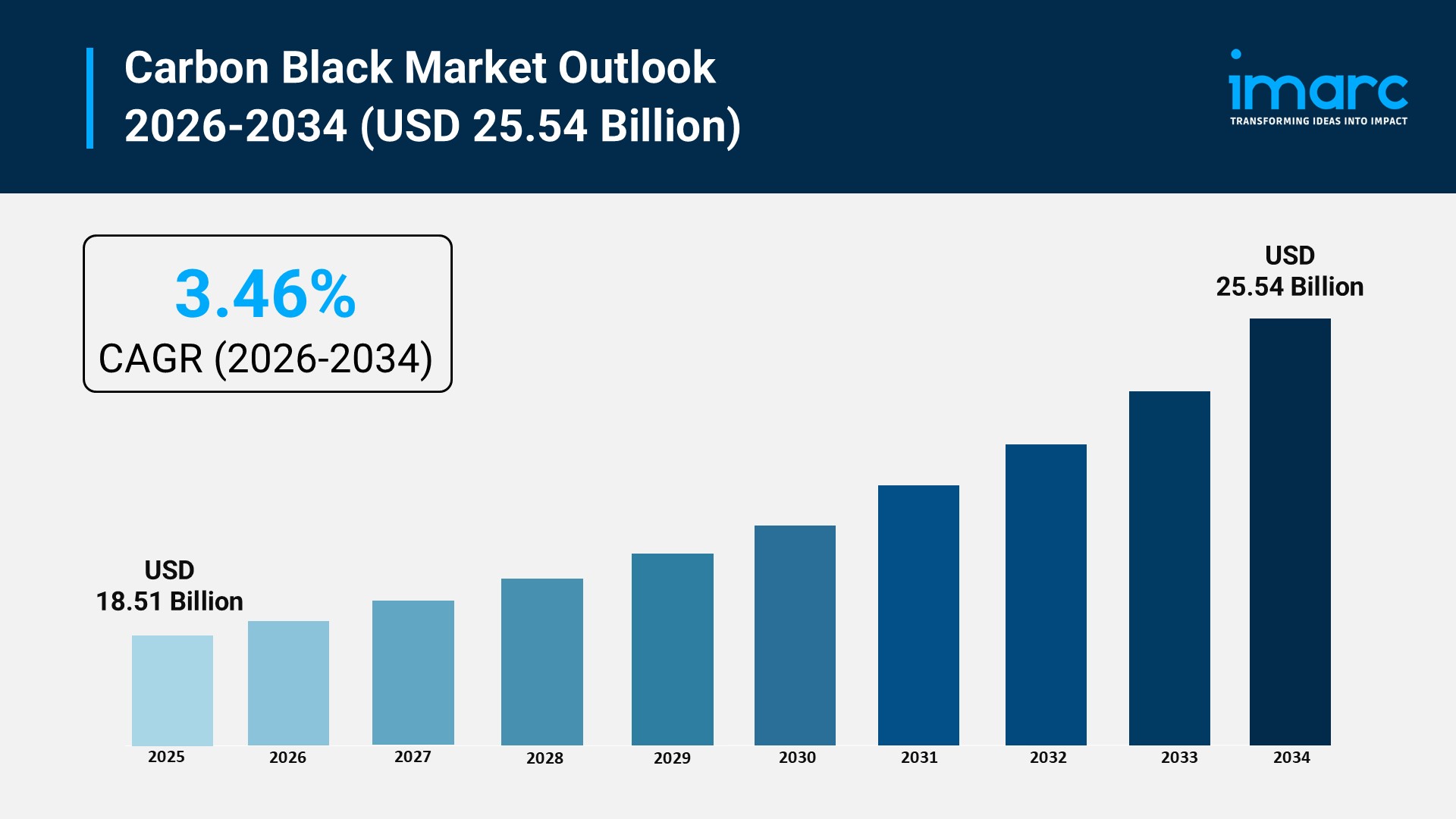
SHERDIAN, WY, UNITED STATES, May 8, 2026 /EINPresswire.com/ — The global carbon black market reached USD 18.51 Billion in 2025 and is projected to reach USD 25.54 Billion by 2034, expanding at a CAGR of 3.46% during 2026–2034, according to the latest market research report by IMARC Group. Growth is anchored by the Tire application segment (70.2% share), dominance of Furnace Black type (76.6%), Standard Grade leading at 84.3%, Asia Pacific’s commanding regional position at over 51.1%, and rapid advances in recovered carbon black technology and specialty grade innovation.
𝐑𝐞𝐩𝐨𝐫𝐭 𝐇𝐢𝐠𝐡𝐥𝐢𝐠𝐡𝐭𝐬
• 𝐌𝐚𝐫𝐤𝐞𝐭 𝐒𝐢𝐳𝐞 (𝟐𝟎𝟐𝟓): 𝐔𝐒𝐃 𝟏𝟖.𝟓𝟏 𝐁𝐢𝐥𝐥𝐢𝐨𝐧
• 𝐅𝐨𝐫𝐞𝐜𝐚𝐬𝐭 (𝟐𝟎𝟑𝟒): 𝐔𝐒𝐃 𝟐𝟓.𝟓𝟒 𝐁𝐢𝐥𝐥𝐢𝐨𝐧
• 𝐂𝐀𝐆𝐑 (𝟐𝟎𝟐𝟔–𝟐𝟎𝟑𝟒): 𝟑.𝟒𝟔%
• 𝐋𝐞𝐚𝐝𝐢𝐧𝐠 𝐑𝐞𝐠𝐢𝐨𝐧: 𝐀𝐬𝐢𝐚 𝐏𝐚𝐜𝐢𝐟𝐢𝐜 (𝟓𝟏.𝟏%)
• 𝐓𝐨𝐩 𝐀𝐩𝐩𝐥𝐢𝐜𝐚𝐭𝐢𝐨𝐧: 𝐓𝐢𝐫𝐞 (𝟕𝟎.𝟐%)
• 𝐋𝐞𝐚𝐝𝐢𝐧𝐠 𝐓𝐲𝐩𝐞: 𝐅𝐮𝐫𝐧𝐚𝐜𝐞 𝐁𝐥𝐚𝐜𝐤 (𝟕𝟔.𝟔%)
• 𝐋𝐞𝐚𝐝𝐢𝐧𝐠 𝐆𝐫𝐚𝐝𝐞: 𝐒𝐭𝐚𝐧𝐝𝐚𝐫𝐝 𝐆𝐫𝐚𝐝𝐞 (𝟖𝟒.𝟑%)
• 𝐔𝐒 𝐒𝐡𝐚𝐫𝐞 𝐢𝐧 𝐍𝐨𝐫𝐭𝐡 𝐀𝐦𝐞𝐫𝐢𝐜𝐚: 𝟏𝟎%
𝐃𝐨𝐰𝐧𝐥𝐨𝐚𝐝 𝐚 𝐅𝐫𝐞𝐞 𝐒𝐚𝐦𝐩𝐥𝐞 𝐂𝐨𝐩𝐲 𝐨𝐟 𝐭𝐡𝐞 𝐑𝐞𝐩𝐨𝐫𝐭: https://www.imarcgroup.com/carbon-black-market/requestsample
𝐂𝐚𝐫𝐛𝐨𝐧 𝐁𝐥𝐚𝐜𝐤 𝐌𝐚𝐫𝐤𝐞𝐭 𝐎𝐮𝐭𝐥𝐨𝐨𝐤 𝟐𝟎𝟐𝟔–𝟐𝟎𝟑𝟒
Carbon black is a fine particulate form of carbon produced through the incomplete combustion of petroleum products. It’s one of those materials that’s everywhere but rarely talked about embedded in the tires on your car, the cables in your walls, the plastic in your phone case, and the ink in your packaging. What makes it strategically important is its combination of reinforcing, conductive, and pigmenting properties that few other materials can replicate at scale.
The market reached USD 18.5 Billion in 2025 and is on track to reach USD 25.5 Billion by 2034. The tire industry alone accounts for 70.2% of global consumption, but the more interesting story is what’s happening in the other 30%: the rise of recovered carbon black, growing EV-related applications, specialty grades for coatings and electronics, and tightening environmental standards that are reshaping production across every major market.
𝐂𝐚𝐫𝐛𝐨𝐧 𝐁𝐥𝐚𝐜𝐤 𝐌𝐚𝐫𝐤𝐞𝐭 𝐃𝐫𝐢𝐯𝐞𝐫𝐬 𝟐𝟎𝟐𝟔
• 𝐒𝐮𝐫𝐠𝐢𝐧𝐠 𝐃𝐞𝐦𝐚𝐧𝐝 𝐟𝐫𝐨𝐦 𝐭𝐡𝐞 𝐓𝐢𝐫𝐞 𝐚𝐧𝐝 𝐀𝐮𝐭𝐨𝐦𝐨𝐭𝐢𝐯𝐞 𝐈𝐧𝐝𝐮𝐬𝐭𝐫𝐲
Carbon black accounts for roughly 30% of a tire’s total weight a fact that alone explains a large chunk of global demand. As vehicle production scales up, so does the need for carbon black. India, for instance, manufactured more than 28.43 million vehicles in a recent fiscal year, driving enormous tire consumption. The shift toward high-performance tires engineered for better fuel efficiency, grip, and safety is intensifying demand for specialized grades. China, the world’s largest producer and consumer, turns out over 5 million tons annually, and appetite shows no sign of slowing.
• 𝐆𝐫𝐨𝐰𝐢𝐧𝐠 𝐂𝐨𝐧𝐬𝐭𝐫𝐮𝐜𝐭𝐢𝐨𝐧 𝐚𝐧𝐝 𝐈𝐧𝐟𝐫𝐚𝐬𝐭𝐫𝐮𝐜𝐭𝐮𝐫𝐞 𝐈𝐧𝐯𝐞𝐬𝐭𝐦𝐞𝐧𝐭
Carbon black has a meaningful role in construction that often goes unnoticed. It pigments colored concrete, reinforces pipes and seals, and improves adhesives and coatings. Industry projections suggest global construction output will grow by approximately USD 4.2 trillion over the next 15 years, creating substantial incremental demand. Governments in Asia, the Middle East, and Latin America are backing large-scale infrastructure programs Saudi Arabia’s Vision 2030 Giga Projects and India’s urban expansion initiatives are prime examples. This consistent infrastructure push gives carbon black producers a demand base that extends well beyond the automotive sector.
• 𝐀𝐝𝐯𝐚𝐧𝐜𝐞𝐬 𝐢𝐧 𝐌𝐚𝐧𝐮𝐟𝐚𝐜𝐭𝐮𝐫𝐢𝐧𝐠 𝐚𝐧𝐝 𝐒𝐮𝐬𝐭𝐚𝐢𝐧𝐚𝐛𝐥𝐞 𝐏𝐫𝐨𝐝𝐮𝐜𝐭𝐢𝐨𝐧
Carbon black manufacturing has become significantly more sophisticated. Process automation and tighter quality controls now allow producers to fine-tune particle size and composition, enabling specialty grades tailored to specific industries. Equally important is the rise of recovered carbon black (rCB), which transforms end-of-life tires into a valuable raw material. CSRC Group and Eco Infinic are building a 30,000-ton-per-year rCB facility in North America, while Klean Industries is setting up four plants across India and Malaysia with combined capacity to process 50,000 metric tons of pyrolysis char annually into high-value rCB.
𝐒𝐩𝐞𝐚𝐤 𝐃𝐢𝐫𝐞𝐜𝐭𝐥𝐲 𝐰𝐢𝐭𝐡 𝐚𝐧 𝐀𝐧𝐚𝐥𝐲𝐬𝐭 𝐟𝐨𝐫 𝐂𝐮𝐬𝐭𝐨𝐦𝐢𝐳𝐞𝐝 𝐈𝐧𝐬𝐢𝐠𝐡𝐭𝐬: https://www.imarcgroup.com/request?type=report&id=1389&flag=C
𝐂𝐚𝐫𝐛𝐨𝐧 𝐁𝐥𝐚𝐜𝐤 𝐌𝐚𝐫𝐤𝐞𝐭 𝐓𝐫𝐞𝐧𝐝𝐬 𝟐𝟎𝟐𝟔
𝐑𝐞𝐜𝐨𝐯𝐞𝐫𝐞𝐝 𝐂𝐚𝐫𝐛𝐨𝐧 𝐁𝐥𝐚𝐜𝐤 𝐌𝐨𝐯𝐞𝐬 𝐟𝐫𝐨𝐦 𝐍𝐢𝐜𝐡𝐞 𝐭𝐨 𝐌𝐚𝐢𝐧𝐬𝐭𝐫𝐞𝐚𝐦
Sustainability pressure is turning recovered carbon black into a genuinely competitive product not just an eco-friendly option. Epsilon Carbon’s Terrablack line delivers performance on par with virgin carbon black but with up to 50% lower global warming potential. More significantly, Sumitomo Rubber Industries and Mitsubishi Chemical have commercialized the world’s first carbon black recycled from tires via coke oven technology destined for motorsport and passenger vehicles alike. This circular approach is reshaping supplier strategies and gaining traction with OEMs under growing pressure to cut Scope 3 emissions across their supply chains.
𝐄𝐥𝐞𝐜𝐭𝐫𝐢𝐜 𝐕𝐞𝐡𝐢𝐜𝐥𝐞𝐬 𝐎𝐩𝐞𝐧𝐢𝐧𝐠 𝐍𝐞𝐰 𝐀𝐩𝐩𝐥𝐢𝐜𝐚𝐭𝐢𝐨𝐧 𝐂𝐡𝐚𝐧𝐧𝐞𝐥𝐬
EVs are expanding the market for carbon black rather than shrinking it. EV tires must handle heavier battery loads, requiring superior wear resistance — a property carbon black directly enables. Beyond tires, carbon black is increasingly used in battery components, conductive plastics, and electrical cables. In Europe, where EVs accounted for roughly 23% of new car registrations recently, producers are already seeing a shift toward specialty-grade demand. Grid expansion programs tied to renewable energy buildout are also lifting wire and cable applications, creating a parallel growth stream that adds to traditional tire-driven volume.
𝐒𝐩𝐞𝐜𝐢𝐚𝐥𝐭𝐲 𝐆𝐫𝐚𝐝𝐞 𝐈𝐧𝐧𝐨𝐯𝐚𝐭𝐢𝐨𝐧 𝐈𝐧𝐭𝐞𝐧𝐬𝐢𝐟𝐲𝐢𝐧𝐠
Product differentiation has become a strategic priority for carbon black producers. While standard grade holds 84.3% of market volume, the higher-margin specialty segment is where competitive battles are intensifying. Birla Carbon introduced its BC1060 grade engineered for anti-vibration components and sealing applications with low hysteresis and high durability at RubberTech 2025 in Shanghai. Epsilon Carbon’s N134 hard carbon black addresses a persistent import-dependency gap in India’s premium tire sector. European producers are developing low-PAH grades to satisfy EU Green Deal chemical regulations, pushing the boundaries of what carbon black can deliver.
𝐀𝐬𝐢𝐚-𝐏𝐚𝐜𝐢𝐟𝐢𝐜 𝐂𝐞𝐦𝐞𝐧𝐭𝐢𝐧𝐠 𝐈𝐭𝐬 𝐒𝐭𝐫𝐮𝐜𝐭𝐮𝐫𝐚𝐥 𝐌𝐚𝐫𝐤𝐞𝐭 𝐋𝐞𝐚𝐝
Asia-Pacific’s dominance in carbon black is rooted in structural advantages that compound over time. China produces over 5 million tons annually, supported by vertically integrated tire and rubber industries. India’s ‘Make in India’ initiative is attracting manufacturing investment, with automotive output exceeding 28 million vehicles in a recent fiscal year. The Asian Development Outlook raised developing Asia’s growth forecast to 5.0%, driven by strong domestic demand and export momentum. With renewable energy investment also lifting wire and cable consumption, the region’s demand story remains exceptionally broad-based and resilient to sector-specific downturns.
𝐂𝐚𝐫𝐛𝐨𝐧 𝐁𝐥𝐚𝐜𝐤 𝐌𝐚𝐫𝐤𝐞𝐭 𝐒𝐞𝐠𝐦𝐞𝐧𝐭𝐚𝐭𝐢𝐨𝐧
𝐁𝐲 𝐓𝐲𝐩𝐞
• Furnace Black
• Channel Black
• Thermal Black
• Acetylene Black
• Others
Leading Segment: Furnace Black leads with around 76.6% market share. Its efficiency, scalability, and versatile applicability across tire manufacturing, coatings, plastics, and rubber products make it the industry’s default production method. The ability to control particle size and surface chemistry through the furnace process gives manufacturers the flexibility to meet exacting industry specifications.
𝐁𝐲 𝐆𝐫𝐚𝐝𝐞
• Standard Grade
• Specialty Grade
Leading Segment: Standard Grade dominates at 84.3% market share, valued for its cost-effectiveness, broad compatibility with polymers and materials, and reliable supply availability. It serves the bulk of automotive, rubber, plastics, and construction industry needs without supply chain complexity.
𝐁𝐲 𝐀𝐩𝐩𝐥𝐢𝐜𝐚𝐭𝐢𝐨𝐧
• Tire
• Non-Tire Rubber
• Plastics
• Inks and Coatings
• Others
Leading Segment: Tire commands 70.2% of the market, supported by carbon black’s essential role as a reinforcing agent that enhances tread wear, tensile strength, and heat dissipation. The global expansion of automotive markets in developing economies and the growing demand for performance and EV-spec tires keep this segment firmly at the top.
𝐑𝐞𝐠𝐢𝐨𝐧𝐚𝐥 𝐈𝐧𝐬𝐢𝐠𝐡𝐭𝐬: 𝐂𝐚𝐫𝐛𝐨𝐧 𝐁𝐥𝐚𝐜𝐤 𝐌𝐚𝐫𝐤𝐞𝐭
𝐀𝐬𝐢𝐚 𝐏𝐚𝐜𝐢𝐟𝐢𝐜 – 𝐌𝐚𝐫𝐤𝐞𝐭 𝐋𝐞𝐚𝐝𝐞𝐫 (𝟓𝟏.𝟏% 𝐬𝐡𝐚𝐫𝐞)
Asia Pacific is the undisputed leader in global carbon black consumption, and the margin is substantial. China alone produces more than 5 million tons annually and is both the world’s largest manufacturer and consumer. India’s automotive sector hit 28.43 million vehicles in a recent fiscal year, and initiatives like ‘Make in India’ continue to attract foreign investment into domestic manufacturing. Demand from the electronics and plastics sectors in Japan and South Korea adds further depth. The Asian Development Outlook raised developing Asia’s growth forecast to 5.0%, reinforcing the region’s near-term demand outlook.
𝐍𝐨𝐫𝐭𝐡 𝐀𝐦𝐞𝐫𝐢𝐜𝐚 (𝐔𝐒: 𝟖𝟔.𝟏𝟎% 𝐨𝐟 𝐫𝐞𝐠𝐢𝐨𝐧𝐚𝐥 𝐬𝐡𝐚𝐫𝐞)
The U.S. market is anchored by one of the world’s most productive automotive industries over 9 million vehicles manufactured annually and a robust tire supply chain. Carbon black’s use in plastics, coatings, and wire and cable applications is expanding as grid infrastructure investment picks up. The growth of electric vehicles is creating new demand in battery components and EV-spec tire compounds. Cabot Corporation and Orion Engineered Carbons represent a strong domestic production base. A recent joint venture between CSRC Group and Eco Infinic will add 30,000 tons of recovered carbon black capacity annually in North America by 2026.
𝐄𝐮𝐫𝐨𝐩𝐞
Europe’s carbon black market is shaped by strong environmental regulation and a world-class automotive industry that produces over 13.1 million vehicles per year. EVs accounted for roughly 23% of new car registrations recently, creating growing demand for specialty grades in EV tire formulations and battery components. The EU Green Deal is pushing producers toward low-PAH and recovered carbon black to comply with tightening chemical standards. Germany, France, and Italy are the leading demand markets, while the expanding e-commerce sector is lifting demand for carbon black in packaging materials and coatings.
𝐋𝐚𝐭𝐢𝐧 𝐀𝐦𝐞𝐫𝐢𝐜𝐚
Brazil and Mexico anchor Latin America’s carbon black market, driven by growing tire and automotive manufacturing sectors. Brazil’s auto industry produced approximately 2.3 million vehicles in a recent year, while Mexico’s expanding plastics sector driven by e-commerce growth is boosting specialty carbon black demand. The region is also becoming more engaged with recovered carbon black technologies as sustainability expectations from multinational OEM customers intensify. Infrastructure construction across Colombia, Chile, and Peru is adding incremental demand for carbon black in coatings, paints, and piping systems.
𝐌𝐢𝐝𝐝𝐥𝐞 𝐄𝐚𝐬𝐭 𝐚𝐧𝐝 𝐀𝐟𝐫𝐢𝐜𝐚
Infrastructure-driven growth and a strengthening automotive assembly sector are the primary demand drivers in the Middle East and Africa. Saudi Arabia and the UAE’s large-scale infrastructure programs particularly under Vision 2030 are creating demand for carbon black in pipes, coatings, and construction materials. South Africa and Nigeria lead automotive assembly activity in Africa, driving rubber and tire applications. Renewable energy development across the GCC is growing wire and cable demand. Producers are also beginning to invest in environmentally aligned production methods to align with the region’s emerging sustainability commitments.
𝐕𝐢𝐞𝐰 𝐭𝐡𝐞 𝐅𝐮𝐥𝐥 𝐑𝐞𝐩𝐨𝐫𝐭: https://www.imarcgroup.com/carbon-black-market
𝐊𝐞𝐲 𝐂𝐨𝐦𝐩𝐚𝐧𝐢𝐞𝐬 𝐢𝐧 𝐭𝐡𝐞 𝐂𝐚𝐫𝐛𝐨𝐧 𝐁𝐥𝐚𝐜𝐤 𝐌𝐚𝐫𝐤𝐞𝐭
Major players profiled in the IMARC Group report include:
• Cabot Corporation
• Birla Carbon
• Orion S.A.
• PCBL Chemical Limited
• Tokai Carbon Co., Ltd.
• Omsk Carbon Group
• Anhui Black Cat Material Science Co., Ltd.
• OCI Company Ltd.
• International CSRC Investment Holdings Co., Ltd.
𝐊𝐞𝐲 𝐓𝐚𝐤𝐞𝐚𝐰𝐚𝐲𝐬 𝐟𝐫𝐨𝐦 𝐭𝐡𝐞 𝐑𝐞𝐩𝐨𝐫𝐭
• Market projected to grow from USD 18.5 Billion (2025) to USD 25.5 Billion by 2034 at a 3.46% CAGR.
• Tire application leads the market with a 70.2% share, supported by global vehicle production growth and high-performance tire demand.
• Furnace Black is the dominant type at 76.6% market share, valued for its production efficiency and versatile applicability.
• Standard Grade accounts for 84.3% of market volume, while specialty grades are the fastest-growing segment by innovation activity.
• Asia Pacific commands over 51.1% of the global market, driven by China’s 5 million+ ton annual output and India’s expanding automotive sector.
• Recovered carbon black (rCB) is emerging as a mainstream product category, with commercial facilities being established in North America, India, Malaysia, and India.
• EV adoption and renewable energy grid expansion are opening new application channels for carbon black beyond traditional tire markets.
𝐎𝐭𝐡𝐞𝐫 𝐓𝐫𝐞𝐧𝐝𝐢𝐧𝐠 𝐑𝐞𝐩𝐨𝐫𝐭𝐬 𝐁𝐲 𝐈𝐦𝐚𝐫𝐜 𝐆𝐫𝐨𝐮𝐩:
Finite Element Analysis Market Research Report
Tungsten Carbide Market Research Report
𝐅𝐢𝐛𝐞𝐫𝐠𝐥𝐚𝐬𝐬 𝐏𝐢𝐩𝐞𝐬 𝐌𝐚𝐫𝐤𝐞𝐭: https://www.imarcgroup.com/fiberglass-pipes-market
𝐁𝐚𝐭𝐭𝐞𝐫𝐲 𝐑𝐞𝐜𝐲𝐜𝐥𝐢𝐧𝐠 𝐌𝐚𝐫𝐤𝐞𝐭: https://www.imarcgroup.com/battery-recycling-market
𝐖𝐚𝐱 𝐌𝐚𝐫𝐤𝐞𝐭: https://www.imarcgroup.com/wax-market
𝐀𝐛𝐨𝐮𝐭 𝐈𝐌𝐀𝐑𝐂 𝐆𝐫𝐨𝐮𝐩
IMARC Group is a leading market research company that offers management strategy and market research worldwide. The company partners with clients across all sectors and regions to identify their highest-value opportunities, address their most critical challenges, and transform their businesses. IMARC’s information products cover major market, scientific, economic, and technological developments for business leaders in pharmaceutical, industrial, and high-technology organizations.
𝐂𝐨𝐧𝐭𝐚𝐜𝐭 𝐔𝐬
IMARC Group
134 N 4th St., Brooklyn, NY 11249, USA
Email: sales@imarcgroup.com
Tel: +1-631-791-1145
Website: https://www.imarcgroup.com
Elena Anderson
IMARC Services Private Limited
+1 201-971-6302
email us here
Legal Disclaimer:
EIN Presswire provides this news content “as is” without warranty of any kind. We do not accept any responsibility or liability
for the accuracy, content, images, videos, licenses, completeness, legality, or reliability of the information contained in this
article. If you have any complaints or copyright issues related to this article, kindly contact the author above.

Media gallery