GA, UNITED STATES, June 5, 2026 /EINPresswire.com/ — Porous materials are the preferred choice for high-power laser coating applications. Scientists in China developed a method for preparing porous SiO2 materials by combining electron beam co-evaporation with selective chemical etching. Based on this method, all-silica ultraviolet laser high-reflection and antireflection coatings were fabricated, both of which exhibited excellent laser-induced damage resistance. This technique is of great significance for the development of large-scale laser facilities.
With the rapid advancement of high-power laser technology, particularly in cutting-edge fields such as inertial confinement fusion (ICF), there is an increasing demand for optical coatings with high laser damage resistance. Using the wide-bandgap material SiO2 for both the high-refractive-index (high-n) and the low-n layer (dense and porous SiO2) is a promising strategy to significantly enhance the laser-induced damage threshold (LIDT). However, conventional methods for preparing porous coating, such as sol-gel and glancing angle deposition, face challenges like severe cracking in multilayer structures and poor uniformity on large-aperture substrates.
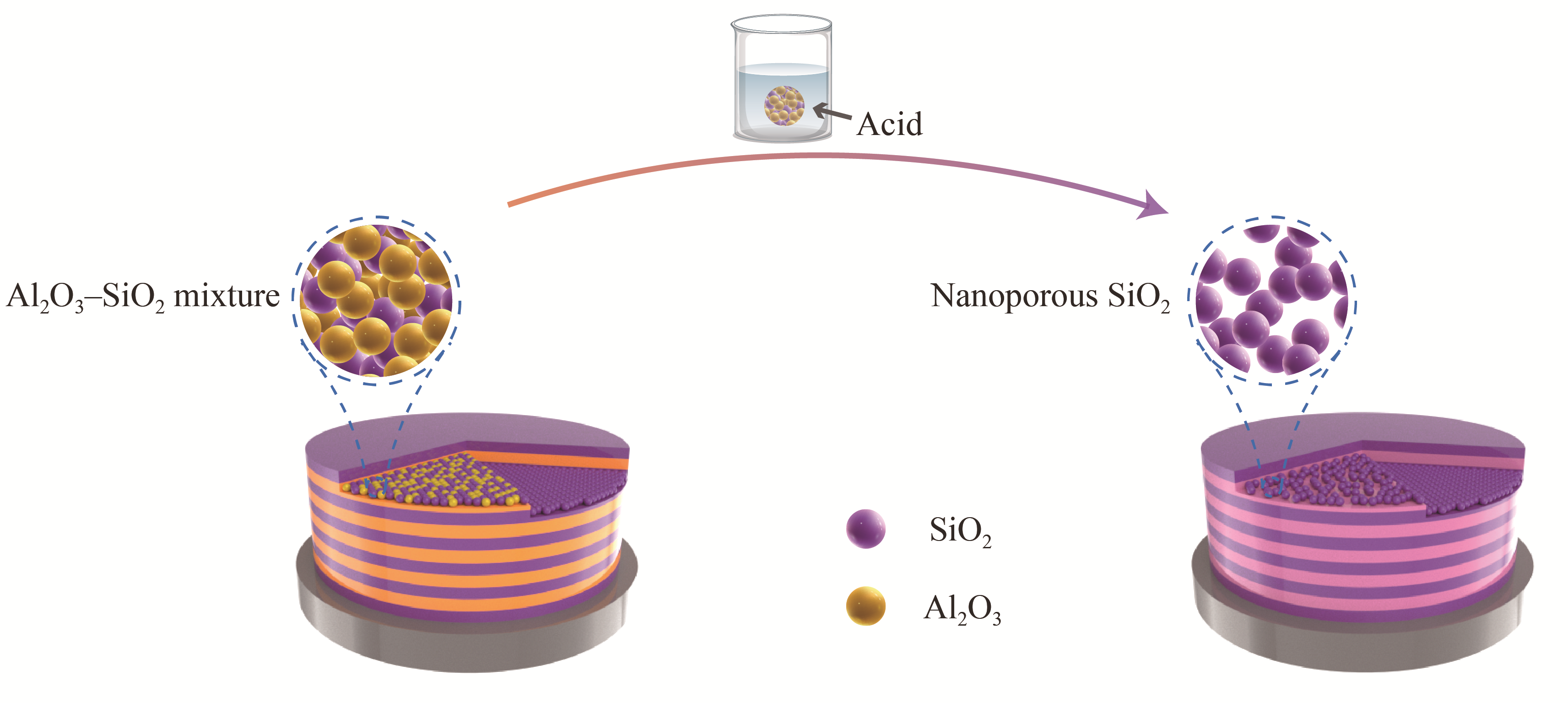
In a new paper published in Light: Advanced Manufacturing, a research team led by Professor Jianda Shao and Professor Meiping Zhu from the Shanghai Institute of Optics and Fine Mechanics, Chinese Academy of Sciences, has developed a new approach based on selective chemical etching of mixture materials. First, an Al2O3–SiO2 mixture coating is deposited using plasma-assisted electron-beam co-evaporation. Subsequently, a chemical etching process using an acid solution removes the Al2O3 from the mixture, leaving behind a porous SiO2 structure. By optimizing the mixing ratio and the etching solution, the etching efficiency is significantly improved.
Based on this method, the team successfully fabricated uniform porous SiO2 monolayer coatings on large-scale fused silica substrates measuring 200 mm × 120 mm × 30 mm, achieving variations in refractive index and thickness of better than ±1%, thereby demonstrating demonstrates the feasibility of the approach for manufacturing large-size components. Furthermore, they designed and fabricated all-SiO2 high-reflection and anti-reflection coatings. Both coatings exhibited absorption levels comparable to that of the fused silica substrate (~10 ppm) at 355 nm, along with excellent laser damage resistance. Notably, the LIDT of the anti-reflection coating reached 46.9 J/cm2, surpassing that of the fused silica substrate (41.1 J/cm2).
This research proposes an all-silica ultraviolet laser coating based on a novel nanoporous material preparation method, which is suitable for the fabrication of large-scale multilayer ultraviolet laser coatings. This cost-effective and scalable approach opens new avenues for the design and fabrication of critical optical components for future high-power laser systems.
References
DOI
10.37188/lam.2026.041
Original Source URL
https://doi.org/10.37188/lam.2026.041
Funding information
This work was supported by the Program of Shanghai Academic Research Leader (23XD1424100), CAS Project for Young Scientists in Basic Research (YSBR-081), Shanghai Leading Talent Program, and National Natural Science Foundation of China (61975215).
Lucy Wang
BioDesign Research
email us here
Legal Disclaimer:
EIN Presswire provides this news content “as is” without warranty of any kind. We do not accept any responsibility or liability
for the accuracy, content, images, videos, licenses, completeness, legality, or reliability of the information contained in this
article. If you have any complaints or copyright issues related to this article, kindly contact the author above.

Media gallery