Electrical Grid Monitoring (EGM) today announced its patented Accurate Fault Location and Detection™ (AFLD) solution as the first technology that can accurately locate both the time and location of power distribution‑grid faults to within a single pole‑span distance, capabilities which could reduce U.S. customer power outage times from 3-5 hours to approximately one hour, and related utility crew-time costs by 80% from $7 billion annually to around $1 billion annually, based on published industry outage statistics.*
This press release features multimedia. View the full release here: https://www.businesswire.com/news/home/20260611227808/en/
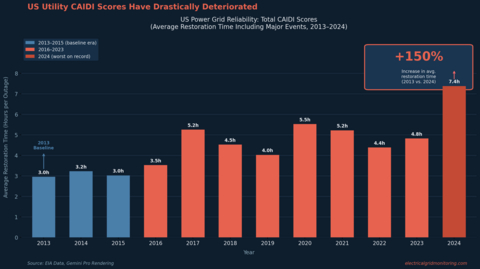
U.S. CAIDI scores are up 150%, with average outage restoration hitting a record 7.4 hours in 2024. EGM’s Accurate Fault Location and Detection™ aims to reverse the trend—locating grid faults to within a single pole-span and potentially cutting outage times to ~1 hour while reducing utility crew costs up to 80%.
The EGM fault-location solution was independently tested in a blind study by the U.S. Department of Energy’s (DOE’s) National Laboratory of the Rockies (NLR) which then provided test data on fault location accuracy to EGM. According to EGM analysts, the study results, which consisted of 26 blind scenarios, showed promise that EGM’s patented Accurate Fault Location and Detection™ (AFLD) solution can locate multiple power distribution‑grid faults to within a single pole‑span distance. **
“We are pleased that the capabilities of EGM’s grid-fault location detection technology have been successfully validated through independent testing at NLR,” said Alex Levran, Ph.D., CEO of Electrical Grid Monitoring. “Our AFLD technology marks a significant advancement in grid‑reliability innovation by delivering an affordable solution that is unique in its ability to accurately identify both the time and location of a fault, which have traditionally been two of the most costly and time-consuming aspects of power-outage resolution.”
Levran explained that utility crews typically spend two-thirds of their time locating faults and one-third repairing them. By shortening detection and resolution times, EGM’s solution reduces costs for utilities and consumers and can potentially cut outage durations by half.
Addressing a costly challenge and reliability concerns
U.S. utilities spend approximately $7 billion annually to dispatch crews for locating and repairing 2.3 million*** power outages. Typical power outages last 2-3 hours, but challenging terrain can extend outages to 7 hours or more. While extreme weather events receive much attention, most interruptions are caused by everyday distribution faults such as branches on laterals, insulator failures, and momentary events.
According to industry estimates, more than 10 million utility “truck rolls” are dispatched yearly in the U.S., costing an average of $1,000 per trip—imposing substantial economic burdens on both utilities and consumers. However, annual utility maintenance costs are increasing due to an aging, overworked grid system, where vast areas contain “blind spots” because they lack detection systems to enable quick fault location and identification.
In its 2025 Report on Evaluating U.S. Grid Reliability and Security, the DOE warned that absent new firm capacity and continued retirement of reliable generation, customer outages could increase by up to 100 times by 2030, with outages rising to more than 800 hours annually in some regions.
The 2025 DOE Pathways to Commercial Liftoff Report says that U.S. electricity demand is expected to increase by 15%-20% in the next decade and double by 2050. In 2025, the DOE launched its “Accelerating Speed to Power” program. The program is designed to accelerate development timelines for large-scale transmission and generation projects to address the growing grid demands for AI, datacenters, and priority onshoring of U.S. manufacturing, while meeting rising demand for affordable, reliable and secure energy.
Reliability and affordability are critical because U.S. electricity prices have reached historic highs, especially in California, where consumers pay 34 cents per kilowatt—120% higher than 15 years ago. And U.S. power reliability metrics continue to worsen: System Average Interruption Duration Index (SAIDI) scores have risen nearly 300% since 2010, and Customer Average Interruption Duration Index (CAIDI) metrics have increased by 160%, according to the International Energy Agency (IEA).
The shift to U.S. manufacturing also requires lower energy rates for companies to profitably compete in international markets. The EGM Meta Alert system offers utilities a cost-effective solution by reducing grid-management expenses, and it will complement future grid configurations associated with mega-datacenters, Levran said. He also said that EGM is moving its own manufacturing facilities to the U.S. to improve efficiencies and reduce both costs and supply chain risks for its customers.
EGM’s system goes beyond fault detection, collecting critical electrical, mechanical, and environmental data—such as voltage, cable temperature, humidity, wind speed, and powerline movement. These parameters help utilities reduce the duration and risk of faults. For example, within minutes, the system can quickly identify incidents caused by heavy winds or fallen trees—such as wildfires, generating actionable data and real-time dashboards for operators.
The EGM Meta-Alert System offers a suite of applications to improve grid performance: power quality, wildfire protection, fault location, dynamic line ratings, and general telemetry. Utilities benefit from reduced service costs, prevention of major outages, and lower energy congestion.
With a return on investment (ROI) under one year, EGM’s offering helps sustain lower energy rates and unlike traditional pole-mounted devices requiring sensors on every pole, EGM deploys clusters of sensors at strategic feeder locations. Each sensor clamps directly onto power lines, capturing comprehensive fault signatures and measuring dozens of parameters previously unavailable. The data is transmitted in real-time to the EGM Meta-Alert™ software, which uses patented algorithms to triangulate fault locations.
The scale of the challenge drew Energy Growth Momentum, a London-based private-equity firm specializing in advancing digital solutions for decarbonized power, to invest in EGM. Energy Growth Momentum led the company’s Series B round, bringing current total funding for EGM to more than $40 million.
“At Energy Growth Momentum, we invest in highly scalable digital solutions that can have an outsized impact on the power grid and energy market,” said Chris Holcroft, an investor and board director at Energy Growth Momentum. “We are particularly focused on dislocations in the transmission and distribution grid, where demand for investment far outstrips supply,” Holcroft said.
Digital solutions can deliver reliability, efficiency, and affordability at scale, but at a fraction of the cost of building new infrastructure, Holcroft said. “EGM offers a complete, low-cost solution accessible to most utilities. We see tremendous potential in fault location for the U.S. market—with an annualized cost-savings potential between $7 billion and $20 billion.”
Alternatives to the EGM system each have limitations—they lack the ability to identify location or other key parameters, they require sensors to be mounted on every pole, which is impractical at utility scale—where networks span millions of poles. Other higher-end solutions are cost prohibitive for all but the largest utilities.
EGM is currently working with the Israel Electric Corporation and multiple U.S. investor‑owned utilities and cooperatives to deploy its technology on live distribution networks.
* & *** (Source: U.S. Public Service Commission data, Energy Information Agency (EIA) Form 861). The results of the EGM pilot study were presented at the Institute of Electrical and Electronics Engineers (IEEE) Conference in May 2026.
**NLR conducted the tests as part of its grid modernization and energy systems research activities. Reference to EGM technology does not constitute endorsement, recommendation, or certification by NLR, the U.S. Department of Energy, or the U.S. government.
About Electrical Grid Monitoring (EGM)
Electric Grid Monitoring (EGM) is a U.S.-based company that builds cost-effective, real-time monitoring systems for electric utility distribution and transmission systems. The company is based in Los Angeles, and is led by CEO Alex Levran, Ph.D. Levran formerly led Power-One, the world’s second-largest global solar-inverter supplier, which grew into a $1 billion solar business before it was sold to ABB in 2013.
View source version on businesswire.com: https://www.businesswire.com/news/home/20260611227808/en/
Media gallery