For decades, healthcare has become increasingly fragmented and complex, resulting in competing systems that, unintentionally but undeniably, work against the people who matter most: clinicians and their patients. Today at its Keynote event in New York City, Abridge unveiled the first AI-native clinician intelligence platform organized around the patient, built for clinicians, and designed to help health systems coordinate the clinical, financial, and evidence-based decisions that shape every moment of care.
This press release features multimedia. View the full release here: https://www.businesswire.com/news/home/20260611779141/en/
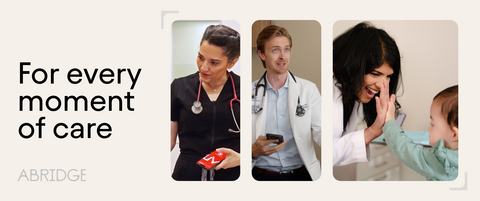
Abridge starts from first principles: The base unit of healthcare is a clinician caring for a patient. Built around that moment, the platform brings intelligence into the workflows clinicians already use—preparing them before the visit, supporting them during the conversation, and reducing administrative burden after care is delivered. As Abridge expands to new models of care delivery, payment alignment, and evidence-based treatment, the platform enables health systems to connect with payers and life sciences organizations through the trusted clinical workflows where care is delivered. The mission remains the same, helping clinicians and health systems improve the experience and outcomes of care for every patient.
“We started Abridge to save time, save money, and save lives. This next chapter brings trusted intelligence into the most important moment in medicine: a clinician caring for a patient. By grounding AI in the clinical conversation, Abridge can free clinicians to focus more on the practice of medicine and less on the process, help health systems improve care delivery, align payment with the care actually delivered, and connect patients to evidence and resources that can improve outcomes,” said Dr. Shiv Rao, CEO and Co-Founder of Abridge.
Abridge is now live at more than 300 health systems, including community health centers, specialty hospitals, and the largest providers in the country, supporting more than 100 million conversations annually. These partners collectively serve more than 250 million patients.
More systems are added weekly. Today, Abridge announced that Northwestern Medicine, Chicago’s premier integrated academic health system, is implementing Abridge enterprise-wide across all its hospitals and care settings.
“By easing documentation demands with Abridge, our clinicians are able to be more present with their patients, resulting in more meaningful interactions and a stronger care experience. Just as importantly, it helps support continuity across the patient journey, enabling more coordinated care before, during, and after each visit,” said Doug King, Chief Information Officer, Northwestern Medicine.
Providers: Intelligence for Every Moment of Care
Clinicians practice medicine to care for patients, not manage administrative tasks. Abridge is becoming the intelligence layer for the whole care journey: before, during, and after the encounter, across care settings, care teams, and clinical workflows.
Before the visit: Abridge prepares clinicians for patient conversations with pre-charted notes and summaries tailored to each specialty and care setting. For inpatient care, Abridge generates pre-round notes with context from emergency department documentation, nursing assessments, labs, imaging, and hospitalist encounters. For outpatient visits, a pre-drafted history of present illness and summary draws from documentation based on prior clinical conversations, as well as the patient’s longitudinal care journey. That same preparation surfaces the care gaps and chronic conditions most relevant to each patient, so clinicians can address what matters during the visit rather than discovering it in a retrospective chart review.
During the visit: Abridge is evolving from passive documentation to active, in-the-moment support for clinicians and patients. The platform enables more comprehensive care by suggesting discussion topics based on the patient summary and the clinical conversation; clinicians can ask evidence-based questions without switching between applications. Abridge’s industry-leading automatic speech recognition and note generation has been validated to capture the encounter in 28+ languages across specialties and care settings.
After the visit: Abridge generates clinical documentation, flowsheets, patient summaries, billing codes, and orders for clinician review. Because that documentation is grounded in the conversation, chronic conditions and care complexity are captured at the level of specificity that reflects the care actually delivered. The platform’s AI agent allows clinicians to tailor outputs using natural language before documentation flows seamlessly into the electronic health record (EHR) for review and signature. Abridge is deeply integrated across leading EHRs, including Epic, Oracle Health, and athenahealth.
The entire platform is designed to remove the barriers that keep clinicians from focusing solely on their patients.
“The patient-provider relationship is at the heart of quality health care, and OCHIN’s goal with every technology integration we offer our members is to support that essential relationship. We are grateful for our innovative partnership with Abridge, which has helped our members reduce clinician burden and free up their capacity to focus on what matters most: caring for their patients in rural and lower-resourced communities,” said Abby Sears, President and CEO of OCHIN.
Clinical Decision Support at the point of care: Abridge Clinical Decision Support brings together insights from leading sources of medical evidence, shaped by the patient record and ongoing clinical conversation, providing clinicians with insights contextualized to that specific patient encounter. New content collaborations with the American Diabetes Association®, American Academy of Family Physicians, Neurology, and the Journal of Clinical Oncology further enrich a care library already anchored by Wolters Kluwer’s UpToDate, The New England Journal of Medicine, and JAMA. In the near term, this content library will expand to encompass specialty-focused evidence and localized clinical protocols. As health systems define their own treatment pathways and quality benchmarks, Abridge will integrate these unique standards to ensure that intelligence is contextualized not only to a clinician’s individual field, but also to the specific institutional environment where care is delivered. Clinicians using Abridge Clinical Decision Support will also be able to claim continuing medical education (CME) credit through a joint providership with MedicusCME.
Additionally, Abridge and the American Heart Association see an opportunity to develop new insights into how cardiovascular care is delivered across health systems at scale by capturing the clinical conversation at the point of care and integrating validated guidelines.
“When the latest evidence is available at the point of care, or at the point of need, it can save time, reduce variability, and support better outcomes for patients. The Heart Association’s responsibility is to help ensure that this science does not remain static but is integrated into the environments where decisions are being made. Licensing our content to Abridge is an opportunity to do exactly that,” said Dr. Mariell Jessup, Chief Science and Medical Officer, American Heart Association.
Abridge for nurses: Abridge is expanding across the inpatient care team. By securely capturing natural nurse-patient conversations during care, Abridge transforms those interactions into structured draft documentation within the EHR, including verbalized findings, education, and interventions. With that documentation becoming part of the shared clinical picture, what a nurse captures at the bedside can be surfaced in pre-charted notes and discussion topics to prepare the next clinician interacting with that patient—context that carries forward across the care team and the full inpatient admission.
“Abridge gives our nurses something invaluable back—their presence. When they’re not buried in documentation, they can actually be with their patients. That’s the real win. Abridge has helped us bring our nursing vacancy rate down from 18% to 8.6% with zero contract staff, and we’ve cut incidental overtime by 70% on the teams where we’ve rolled this out. When you factor in that retraining a single nurse costs nearly $100,000, the financial impact is already significant,” said Misti Foust-Cofield, Vice President & Chief Nursing Officer, Reid Health.
Smart room integrations: Abridge will further power inpatient care through smart room integrations with industry leaders, including Artisight and hellocare.ai. These integrations reflect a broader vision for intelligence in healthcare: technology that works quietly in the background, supports clinical workflows across the inpatient stay, and fits naturally into how care teams already deliver care.
“The hardest part of inpatient care delivery is the handoff. When the room, the documentation, and the patient interaction stop being three separate problems for the care team, you finally get the experience clinicians have been asking for. That is the magic of an Abridge and Artisight integration,” said Hannah Koczka, VP Ventures & Innovation at Northwestern Medicine.
“UCHealth is deploying hellocare’s AI-enabled smart room technology with Abridge’s ambient note-taking support system-wide, fully integrated with our Virtual Health Center. By automating routine tasks and enabling continuous virtual monitoring, we expect this innovative model of care to streamline workflows, reduce cognitive and administrative burden, improve safety and quality, and free nurses and clinicians to focus more of their time on direct patient care,” said Dr. Richard Zane, UCHealth Chief Medical and Innovation Officer.
Payment Alignment: Capturing the Full Picture of Patient Care
As care becomes more complex, clinicians need easier ways to understand the full patient context before they enter the room so they can identify and address care gaps during the visit and capture the care delivered without adding administrative burden. By grounding these workflows in the patient conversation, Abridge helps ensure each patient is accurately represented and connected to the follow-up, resources, and support they need. For health systems and payers, that same complete clinical picture enables quality programs, value-based care, reimbursement, and payment alignment.
Recognizing the full complexity of patient care: Today, when a doctor sees a patient, the information from that visit gets processed, reviewed, and adjudicated over weeks. Critical details about a patient’s health often get lost along the way and billions of dollars of care goes unrecognized every year. Abridge is exploring how health systems and payers can work together through trusted clinical workflows to account for the full clinical picture of each patient at the moment care is delivered.
At the Abridge Keynote today, Deanna Hanisch, CIO of Johns Hopkins Health System, and Dr. Ben Kornitzer, Chief Medical Officer of Aetna, were on stage to discuss how AI embedded in clinical workflows can help clinicians and care teams see the full picture of each patient, identify and address care gaps at the point of conversation, and bring value-based care closer to its original promise: better outcomes, better experiences, and more coordinated support for every patient.
Real-time claims: Abridge is aligning real-time documentation with real-time claims workflows. As AI becomes more common across healthcare administration, the goal should be to reduce friction between providers and payers, rather than automate the adversarial processes that already slow down care delivery and reimbursement. Abridge starts earlier, grounding documentation, billing codes, and claims in the full clinical picture at the moment care is delivered. That shared foundation can help health systems and payers reduce rework, support patients faster, and move closer to real-time adjudication where possible.
“Our mission is to elevate health by delivering compassionate care and innovations that save lives, and we have to do that sustainably. The future cannot be providers and insurers using increasingly sophisticated tools to argue over the record after care has already been delivered. We need shared, trusted infrastructure that helps both sides determine the right payment in real time, reduces unnecessary administrative burden, and ensures more of every healthcare dollar goes where it belongs: to patients and the people caring for them,” said Dr. Joon Lee, Chief Executive Officer of Emory Healthcare.
At the Abridge Keynote today, Emory Healthcare’s Dr. Lee and Madhu Nutakki, CIO of Cigna Healthcare, were on stage to discuss how AI embedded in trusted clinical workflows has the potential to collapse the distance between care delivery and claims reconciliation, bringing real-time adjudication from distant ambition to near-term reality.
Revenue integrity: Real-time adjudication only works if the information moving from provider to payer is accurate, complete, and auditable from the start. Abridge is also partnering with AHIMA, the leading association for health information and medical coding professionals, to support the quality, accuracy, and auditability of Abridge coding outputs. The collaboration will help ensure Abridge’s coding and clinical documentation improvement (CDI) capabilities are evaluated with the rigor expected by the coding profession across fee-for-service and value-based care reimbursement models.
Life Sciences: Supporting Evidence-Based Care and Research Access
The convergence of AI, precision medicine, and real-time clinical intelligence is creating new opportunities to help clinicians identify disease earlier, understand emerging evidence, and connect eligible patients to appropriate research pathways. The systems used to identify potential clinical trial candidates are often disconnected from the moments when clinicians, patients, and clinical context come together.
Abridge can help clinicians and health systems bring trusted intelligence into their own workflows, with appropriate governance, consent, security, and institutional control. Life sciences collaborations will be designed to support evidence-based care and research access by helping clinicians and health systems identify potential trial candidates and initiate appropriate screening pathways at the point of care.
Clinical trial screening, supported by the clinical conversation: For conditions like Alzheimer’s disease, biomarkers and risk indicators can emerge years before diagnosis, and early identification can be crucial. The Abridge platform can compare trusted clinical guidance with the patient record and clinical conversation in real time. When elevated risk is identified, Abridge can suggest discussion topics and next steps for clinicians to consider, including whether trial screening may be appropriate. Depending on what information is already available in the patient record, Abridge can help accelerate the process of identifying potential candidates and initiating screening from the point of care.
Building a Foundation With NVIDIA
Abridge is working with NVIDIA to build a first-of-its-kind foundation model for clinical conversations, supporting the next generation of AI designed for the realities of care delivery. Purpose-built to strengthen Abridge’s core platform for health systems, the model is designed to improve the accuracy, reliability, auditability, and customization of the workflows clinicians already use, from documentation and evidence grounding to workflow automation and clinical reasoning support.
Building on the NVIDIA Nemotron open model family, where both the model weights and training data are available, the new Abridge model will be trained on NVIDIA Blackwell AI infrastructure, using advanced pre-, mid-, and post-training processes with de-identified data. Training across all three stages allows clinical knowledge to be embedded from the ground up, improving accuracy, precision, and reliability across specialties, care settings, and the multi-step workflows that follow the clinical conversation. By domain adapting earlier in the training lifecycle, Abridge can build a model that reasons clinically from its foundation. Nemotron gives Abridge the ability to optimize for quality, cost, and efficiency at every layer, deploying the right model for the right workflow, at the right scale.
“Abridge reset the clinical experience for physicians and patients alike—and every deployment makes their clinical intelligence smarter and more capable,” said Kimberly Powell, Vice President, Healthcare, NVIDIA. “Nemotron is the open frontier model created exactly for this moment, giving Abridge the foundation to break new ground across the entire healthcare ecosystem.”
To watch the Abridge Keynote recording and learn more about the platform and collaborations announced today, sign up here.
View source version on businesswire.com: https://www.businesswire.com/news/home/20260611779141/en/
Media gallery


