Vadzo Imaging’s Falcon-2020BRS streams uncompressed 20MP Bayer sensor data directly over USB 3.2 Gen1, giving embedded vision and machine vision engineers full control over demosaicing, color science, and image processing. The camera also supports Dynamic ROI enabling systems to focus processing resources on important regions of interest while maintaining access to full-resolution RAW sensor data.
FORT WORTH, TX / ACCESS Newswire / August 10, 2026 / Vadzo Imaging, a world leader in OEM Embedded Vision solutions, today announces the validations of Real-Time Dynamic ROI and Auto-Exposure capability on the Falcon-2020BRS 20MP Bayer USB Camera built on the Onsemi AR2020 sensor. The new camera module streams uncompressed Bayer pattern sensor data over a USB 3.2 Gen1 connection, giving engineering teams direct access to raw pixel values before any onboard demosaicing, sharpening, or color correction alters. Machine vision developers, scientific imaging teams, and custom algorithm builders gain a high-resolution sensor output that preserves the full information the AR2020 sensor captured. The Falcon-2020BRS also supports Dynamic ROI functionality, enabling embedded vision systems to selectively process important areas within a high-resolution frame while reducing unnecessary data processing, bandwidth consumption, and computational load.
The Fixed ISP Problem in Standard Color USB Camera Products
Most color USB camera products run captured sensor data through an onboard image signal processor before the image ever reaches the host computer. That processor demosaics the Bayer pattern into RGB, applies gamma correction, adjusts white balance, and often sharpens edges automatically. Those steps are useful for a general-purpose color video stream, but they permanently alter the pixel values that a machine vision algorithm, a scientific imaging pipeline, or a color measurement instrument depends on. Once the onboard ISP has interpolated missing color samples and applied nonlinear tone curves, the original sensor reading cannot be recovered. Engineers building custom demosaicing algorithms, multispectral analysis tools, or precise color measurement systems need the sensor data exactly as the pixel array captured it, not an approximation that a fixed ISP pipeline has already reshaped.
How Uncompressed Bayer RAW Output Preserves Sensor Level Accuracy
A Bayer pattern sensor like the Onsemi AR2020 places a single-color filter over each pixel in a repeating red, green, and blue mosaic rather than capturing all three colors at every location. A standard color camera demosaics this pattern onboard by interpolating the missing color values at each pixel before streaming a finished RGB or YUV image. The Falcon-2020BRS instead streams the AR2020 RAW Sensor output directly, meaning every pixel value that reaches the host is the exact photon count the sensor measured with no interpolation, no gamma curve, and no sharpening filter applied in between.
This AR2020 Dynamic ROI Camera behavior matters most when the downstream algorithm is sensitive to the exact numeric value of each pixel. Photometric stereo, multispectral classification, and precision color measurement all depend on knowing that a pixel value reflects sensor response rather than an interpolation guess or a tone mapping curve applied to make video look pleasing on a monitor. Engineers who need Bayer RAW Camera behavior can implement their own demosaicing, white balance, and color correction in software using exactly the algorithm their application requires instead of accepting whatever fixed pipeline a general-purpose ISP provides.
Vadzo’s engineering team describes this same behavior using the terms RAW Sensor Data Camera, Uncompressed RAW Camera, and Bayer Pattern USB Camera interchangeably because all three describe a camera module that streams unmodified sensor readings instead of a processed video image.
Dynamic ROI Support for Optimized High-Resolution Vision Processing
High-resolution cameras generate large amounts of image data, which can increase processing requirements for embedded systems and AI-based applications. The Falcon-2020BRS supports Dynamic ROI, allowing engineers to define and adjust specific areas of interest within the sensor output based on application needs. By focusing processing resources on critical regions such as objects, inspection areas, machine components, or target zones, Dynamic ROI helps reduce unnecessary data handling while maintaining access to the camera’s full 20MP imaging capability when complete frame analysis is required. This capability enables faster AI inference, improved system responsiveness, and optimized USB bandwidth usage for applications including machine vision inspection, robotics, scientific imaging, and edge AI systems.
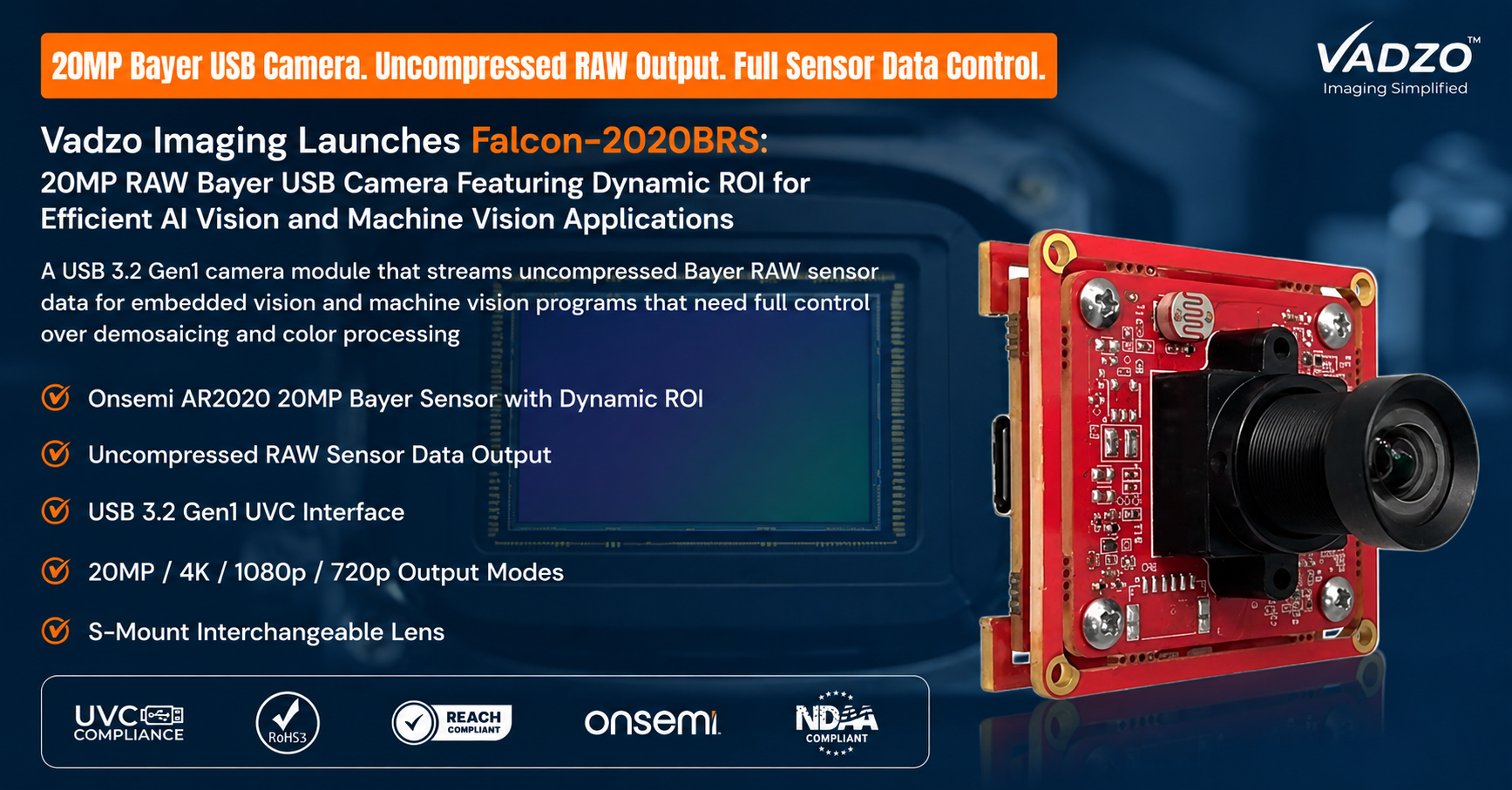
Falcon-2020BRS: 20MP Dynamic ROI USB Camera Built on the Onsemi AR2020 Sensor
Vadzo Imaging’s Falcon-2020BRS is a 20MP Bayer USB Camera built around the Onsemi AR2020 sensor streaming 5120 x 3840 resolution Bayer pattern data directly over USB 3.2 Gen1 without onboard demosaicing or color processing. The camera module ships in a compact S-Mount body and connects to Windows, Linux, and Android host systems through the standard UVC driver stack already built into each operating system. Vadzo factory tests every unit for sensor-level accuracy before shipment, so integrators receive verified raw pixel data rather than an unverified bare sensor board.
Engineers evaluating a AR2020 Bayer USB Camera for a new machine vision program can move directly to the 20MP RAW USB Camera listing on the cart page to review pricing and request a sample. Those researching technical specifications before purchase will find the same 20MP RAW USB Camera documented in full on the Falcon-2020BRS product page alongside an AR2020 RAW USB Camera datasheet and Onsemi AR2020 Bayer Camera test data captured at full resolution. Some engineering teams simply describe the module as a Bayer USB Camera because the sensor color filter pattern defines the entire output format.
Key specs: 20MP (5120 x 3840) | Onsemi AR2020 1/1.8 inch 1.4 µm pixel | Bayer RAW Output | Rolling Shutter | RAW8 / RAW10 / RAW12 | USB 3.2 Gen1 | 20MP / 4K / 1080p / 720p | S-Mount (M12) | Windows Linux Android
Key Capabilities of the Onsemi AR2020 20MP Dynamic ROI Bayer USB 3.2 Gen1 Camera
20MP Resolution with Uncompressed Bayer Sensor Data: Many USB camera products compress or convert sensor data before it reaches the host, which discards information a precision algorithm may need. The Falcon-2020BRS streams a full 20MP (5120 x 3840) Bayer frame from the Onsemi AR2020 sensor without onboard compression or color conversion. 20MP Dynamic ROI USB Camera behavior gives engineers access to every pixel value the sensor produced at full bit depth instead of a compressed approximation.
RAW Bayer Output for Custom Demosaicing and Color Science: A fixed onboard ISP forces every application to accept the same demosaicing algorithm, the same white balance logic, and the same tone curve regardless of what the downstream task actually needs. The Falcon-2020BRS instead delivers a 20MP Dynamic ROI Camera output that leaves demosaicing, white balance, and color correction entirely to the host application. Teams building a RAW Image Processing Camera pipeline can implement demosaicing algorithms tuned to their specific lighting, sensor characteristics, or accuracy requirements instead of working around a black box ISP.
USB 3.2 Gen1 UVC Interface for Driver-Free Integration: Proprietary RAW streaming interfaces often require custom drivers that add engineering time and platform risk to a machine vision program. The Falcon-2020BRS streams Bayer RAW data over a native USB 3.2 Gen1 UVC connection that Windows, Linux, and Android all recognize without a proprietary driver. This USB 3.2 Bayer Camera design lets engineers begin capturing raw frames the same day the hardware arrives using standard V4L2, DirectShow, or AVFoundation calls.
Dynamic ROI for Intelligent Image Analysis: The Falcon-2020BRS enables Dynamic ROI operation, allowing vision systems to prioritize specific image regions instead of continuously processing unnecessary areas of the frame. This improves computational efficiency while maintaining the precision advantage of 20MP Dynamic ROI imaging. For AI vision applications, Dynamic ROI allows algorithms to focus on important regions such as defects, objects, or measurement zones, helping reduce processing latency and improve real-time decision-making performance.
Multiple Output Resolution Modes for Flexible Bandwidth Management: Full resolution RAW capture at every frame is not always necessary during development or during live inference. The Falcon-2020BRS streams 20MP, 4K, 1080p, and 720p output modes selectable through standard UVC controls without a firmware rebuild. Engineers can capture full resolution RAW frames for calibration and algorithm validation while running a lower resolution stream for real-time preview during integration work.
S-Mount Interchangeable Lens for Application-Specific Optics: A fixed lens locks a camera module to a single field of view, which rarely matches every deployment across a scientific imaging bench, a robotics platform, and an industrial inspection cell. The Falcon-2020BRS uses a standard S-Mount (M12) lens holder so integrators can select macro-optics for close-range inspection, wide-angle lenses for broad scene capture, or narrow field lenses for long-range detail without redesigning the camera module.
Compact Module Form Factor for Space Constrained Embedded Designs: Research instruments, portable inspection tools, and compact robotics heads often have limited internal volume for imaging hardware. The Falcon-2020BRS ships as a compact board-level module with the S-Mount lens holder and USB 3.2 Gen1 connector positioned for straightforward mechanical integration into custom OEM housings without a bulky external enclosure.
“Machine vision and scientific imaging teams keep telling Vadzo the same thing. Give us the sensor data exactly as it was captured and let us handle demosaicing and color science ourselves. The Falcon-2020BRS answers that request directly. Streaming uncompressed Bayer data from the Onsemi AR2020 sensor over a standard USB 3.2 Gen1 UVC connection means our customers get full control over image processing without writing a custom driver or reverse engineering a black box ISP.”- Alwin Vincent, Product Manager at Vadzo Imaging.
Application Sections
Machine Vision and Custom Image Processing: Machine vision programs performing precision measurement or classification need pixel values that reflect actual sensor response rather than an ISP’s interpolation guess. A RAW Data Machine Vision Camera built on the Falcon-2020BRS delivers sensor level accuracy directly over USB 3.2 Gen1. Positioned as a Bayer Machine Vision Camera, the module lets algorithm teams implement demosaicing and color correction tuned to their specific inspection task instead of accepting a fixed general-purpose pipeline. With Dynamic ROI capability, inspection systems can concentrate processing power on specific areas of interest, enabling faster defect detection, optimized image analysis, and improved efficiency in high-speed production environments.
Embedded Vision Research and High-Resolution Imaging: Research platforms and prototype vision systems often need full sensor bit depth to validate an algorithm before it moves to a production ISP pipeline. The Falcon-2020BRS functions as a High-Resolution Embedded Vision Camera that gives research teams unmodified 20MP Bayer data for algorithm development. The same module supports a High-Resolution Embedded Bayer Camera role in early-stage prototyping where engineers are still deciding what color science and demosaicing approach their production system will use.
Embedded Vision Inspection and Quality Control: Inspection stations comparing part color or surface finish against a reference need consistent pixel-level accuracy that a fixed ISP’s automatic gain and color correction can quietly shift over time. An Embedded Vision Inspection Camera configuration of the Falcon-2020BRS holds the exact sensor reading constant, so a measurement taken today matches a measurement taken next year under the same lighting. Deployed as a Bayer Inspection Camera on a multi-shift production line, the module lets quality teams apply their own calibrated color correction instead of trusting an opaque onboard algorithm. The Falcon-2020BRS also supports Dynamic ROI workflows, allowing inspection systems to prioritize specific areas of a captured frame that require detailed analysis. By focusing processing resources on critical inspection zones such as surface defects, component edges, or measurement regions, Dynamic ROI helps reduce unnecessary image processing workloads while maintaining the accuracy benefits of 20MP Bayer RAW data. This enables faster inspection cycles, optimized bandwidth usage, and improved real-time decision-making for automated quality control systems.
OEM Embedded Vision Product Development: Product teams building a custom vision system around raw sensor data need a supplier who treats camera integration as a program rather than a component purchase. Vadzo Imaging supports OEM teams building an OEM Bayer Camera Module program with board redesign options, lens holder changes, and firmware customization around the same Onsemi AR2020 core. Teams describing Vadzo as a Bayer Camera Manufacturer value the same factory testing and documentation across every unit in a production run.
Scientific and Multispectral Imaging: Multispectral and scientific imaging setups depend on knowing precisely what light reached each pixel without a color correction algorithm reshaping the signal beforehand. The Falcon-2020BRS supports a RAW Format Vision Camera role in laboratory instruments and analytical equipment where the research team implements its own calibrated color science. Embedded Vision RAW Camera deployments in these settings benefit from the sensor’s full 20MP resolution and rolling shutter architecture for detailed sample capture. Dynamic ROI further enhances scientific imaging workflows by allowing researchers to isolate and analyze specific regions of interest within a larger scene. This capability helps reduce processing requirements when only selected areas require detailed analysis, while still preserving the complete RAW sensor information when full-frame capture is needed. For laboratory instruments and analytical systems, Dynamic ROI provides greater flexibility between high-resolution measurement and efficient real-time processing.
Frequently Asked Questions
Q: What is the difference between a Bayer RAW camera and a standard processed color USB camera for embedded vision development?
A: A standard processed color USB camera runs sensor data through an onboard image signal processor that demosaics, color corrects, and often sharpens the image before it reaches the host computer. A Bayer RAW camera skips that process entirely and streams the sensor’s original pixel readings, so every value reflects exactly what the sensor measured. Vadzo Imaging offers both processed color and RAW output camera products because different embedded vision programs need different levels of control over the image pipeline. A team of writing custom algorithms typically prefers the accuracy that unmodified sensor data provides.
Q: Why would a machine vision engineer prefer uncompressed RAW sensor data over an already processed image?
A: An already processed image has been demosaiced, color corrected, and sometimes sharpened using a fixed algorithm chosen by the camera manufacturer rather than the application developer. That processing can introduce interpolation artifacts or shift pixel values in ways that reduce accuracy for measurement, classification, or scientific analysis of tasks. Uncompressed RAW sensor data preserves the sensor’s original reading at each pixel location, so the engineer controls every step of the image pipeline instead of inheriting decisions baked into a black box processor. Vadzo Imaging builds its RAW output camera products specifically for engineering teams that need this level of control over their vision pipeline.
Q: Does streaming uncompressed Bayer data increase the data rate compared to a standard compressed video stream?
A: Yes. Uncompressed RAW data carries more information per frame than a compressed video stream because no compression algorithm has discarded or approximated any pixel values. Engineers planning a system around a high-resolution RAW camera should budget USB bandwidth and host storage accordingly, particularly at full sensor resolution and high frame rates. Vadzo Imaging’s applications engineering team helps OEM customers select the output resolution and frame rate combination that fits their available USB bandwidth without sacrificing the data integrity a RAW pipeline is meant to provide.
Q: Can standard software running on a host PC or embedded board handle the demosaicing and color processing for a Bayer RAW camera?
A: Yes. Popular open-source libraries, including OpenCV, provide demosaicing and color correction functions that work directly with Bayer pattern data from a RAW camera. Embedded boards running Linux, Windows, or Android can run these libraries in real time for many applications. GPU-accelerated demosaicing is available on platforms with sufficient compute headroom for higher frame rates. Vadzo Imaging provides sample capture and processing code so engineering teams can start from a working reference implementation instead of writing a demosaicing pipeline from a blank page.
Q: What makes Vadzo Imaging a reliable source for embedded vision camera products that output unmodified raw sensor data?
A: Vadzo Imaging factory tests every RAW output camera module against the sensor’s published specifications, so integrators receive verified performance data rather than an unverified bare sensor board. Engineering teams get complete mechanical drawings, driver documentation, and sample processing code with every evaluation kit, so a program can move from first sample to production without hunting for missing technical resources. Vadzo also supports board redesigns, firmware customization, and long-term supply commitments for OEM programs, building custom vision pipelines around raw sensor output. This consistency is why engineering teams building precision measurement, scientific imaging, and custom machine vision systems return to Vadzo Imaging for successive camera module generations.
Availability
The Falcon-2020BRS 20MP Bayer USB Camera built on the Onsemi AR2020 sensor is available now for evaluation and production orders. Evaluation kits include the camera module, an S-Mount lens, a USB 3.2 Gen1 cable, and a platform driver for documentation with no minimum order requirement. Browse the full Vadzo camera portfolio at https://www.vadzoimaging.com/ or contact Vadzo at alwin@vadzoimaging.com to request an evaluation kit or discuss OEM integration requirements.
About Vadzo Imaging
Vadzo Imaging is a global provider of embedded vision camera products serving OEMs and system integrators in robotics, industrial automation, unmanned aerial systems, edge AI, and scientific imaging markets. Vadzo designs every camera module for straightforward integration with leading embedded computing platforms and backs its products with hardware customization, firmware development, and module-level driver support that shortens the path from evaluation to production deployment.
Media Contact
Alwin Vincent
Vadzo Imaging
Email: alwin@vadzoimaging.com
LinkedIn: Vadzo Imaging
YouTube: Vadzo Imaging
X: Vadzo Imaging
SOURCE: Vadzo Imaging
View the original press release on ACCESS Newswire
Media gallery