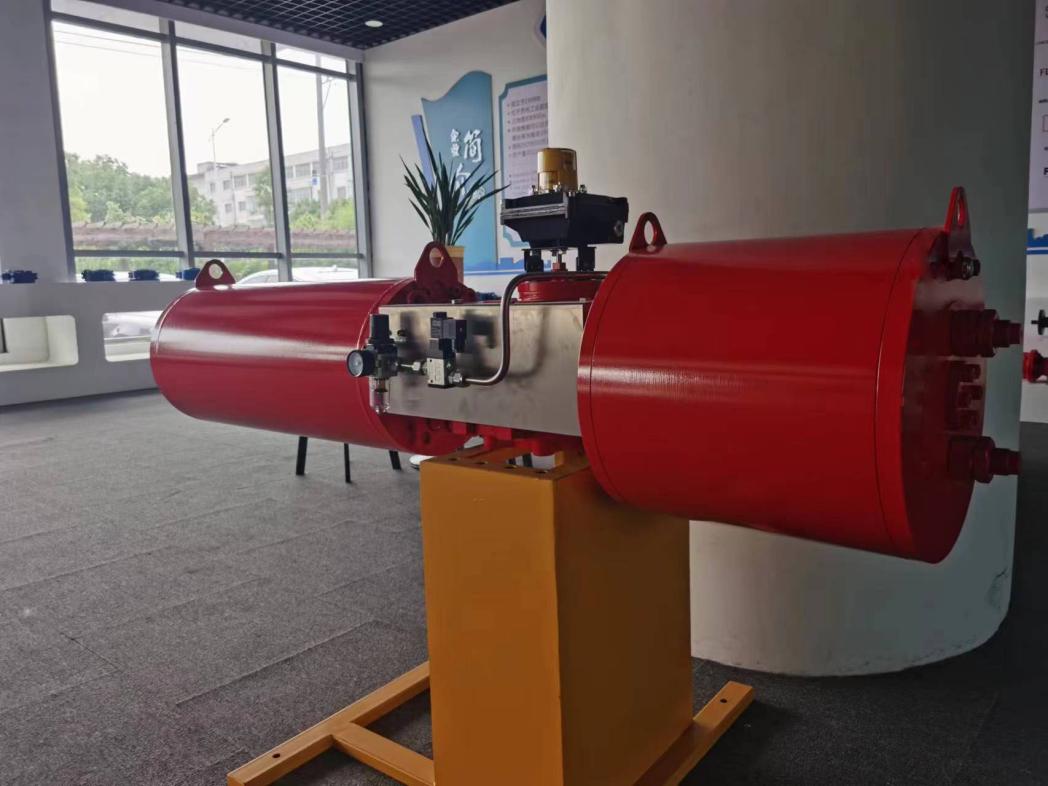
SUZHOU, JIANGSU, CHINA, August 28, 2026 /EINPresswire.com/ — Industrial facilities rely on precise control for high-risk operations; configuring a fail-safe system requires more than specifying torque. STARD GEARS addresses this by engineering the Emergency Shutdown Actuator around a YP Series spring-return Scotch Yoke architecture. This aligns actuator configurations with the safe state, worst-case torque, and failure direction. While a spring module provides fail-safe capability, STARD GEARS emphasizes that mechanical return cannot replace validation of shutdown times, diagnostics, and Emergency Shutdown (ESD) approvals. By treating the actuator as the safety loop’s foundation, STARD GEARS helps transition from theoretical requirements to field performance.
Emergency Shutdown Actuator Selection Begins with the Safe Process State
When designing an isolation system, the STARD GEARS methodology dictates that selection begins by defining the mandatory safe position the valve reaches during incidents. Engineers determine allowable action times and worst-case torque before selecting a mechanical drive. STARD GEARS matches these critical parameters with its YP Series spring-return Scotch Yoke architecture.
The YP series operates quarter-turn valves, compatible with ball, butterfly, and plug valves in critical applications. Utilizing a robust spring-return structure, this actuator provides the mechanical foundation for a reliable return to the safe position upon air loss. Whether a system fails open or closed is determined through hazard analysis; it cannot be uniformly prescribed by the manufacturer.
Configuring the correct actuator requires detailed evaluation. Minimum available air supply pressure, maximum differential pressure, internal friction, temperature extremes, and safety factors dictate cylinder dimensions and spring configuration. The YP series supports a 3 to 7 barg working pressure range, providing the pneumatic force needed to overcome operational resistance.
Yoke Profile and Spring Torque Must Cover the Worst-Case Valve Load
Quarter-turn valves exhibit complex torque signatures, requiring the actuator’s output curve to match these demands. The choice between symmetrical and canted yoke profiles is driven by break, run, and seat torque requirements. A canted yoke delivers high torque at stroke ends, suitable for large butterfly valves. A symmetrical yoke provides balanced torque output, aligning well with ball and plug valves.
In emergencies, the spring return mechanism maintains output force to drive the valve to its safe position under adverse conditions. STARD GEARS incorporates pre-compressed spring modules ensuring consistent mechanical force while reducing maintenance risks. This modular approach allows precise configuration, matching springs to fail-action requirements. The actuators feature non-pressurized end caps, providing 90-degree rotation with an adjustable range of ±5 degrees for seating.
Mechanical torque output is one component of total response capability. Shutdown action time is influenced by pneumatic circuitry sizing, including port diameters, solenoid capacities, exhaust rates, and supplementary volume tanks.
The ESD Package Includes Controls, Feedback and Diagnostics
A reliable emergency shutdown actuator is never deployed isolated; it functions as a safety loop’s central component. ESD system performance is determined by integrating the pneumatic actuator with accessories, including solenoid valves, limit switches, position transmitters, and diagnostic modules. STARD GEARS recognizes that the mechanical drive must seamlessly interface with control elements to ensure coordinated incident response.
To facilitate integration, actuators feature standardized NAMUR mounting interfaces supporting direct attachment of common control accessories without custom bracketing. This eliminates configuration bottlenecks. Furthermore, ISO connection dimensions establish a universal boundary for integrating the actuator with the valve stem, ensuring structural integrity and precise alignment.
Project engineers must define specific de-energize-to-trip logic, return sequences, bypass protocols, partial-stroke testing intervals, and fault alarm thresholds. Accessory documentation, regarding hazardous area classifications and functional safety ratings, must strictly align with the actuator model, failure direction, and environmental conditions. The actuators support an IP67 protection rating.
Testing Must Reproduce Loss-Of-Air and End-Position Conditions
Theoretical calculations and design specifications are validated through rigorous physical testing, ensuring expected performance during critical events. Accepting an ESD package requires tests simulating instrument air loss, verifying end-position seating, measuring action time, and confirming feedback logic. This comprehensive testing ensures the actuator completes the mandated safe action under accident conditions.
STARD GEARS maintains in-house testing capabilities, equipped with dedicated torque measurement rigs and lifecycle testing equipment. This infrastructure forms the foundation for factory acceptance testing and quality verification. Quality control covers the entire manufacturing spectrum. During factory testing, technicians accurately record applied air pressure, simulated valve load, ambient temperature, action time, end-position feedback signals, and spring return stroke performance.
Factory torque and lifecycle testing establish a measurable hardware baseline, while site acceptance testing remains necessary to confirm the installed ESD package under actual project conditions. Field commissioning teams should verify air-supply isolation procedures, accessory interlocking logic, bypass-switch status, and periodic testing protocols against the approved safety function.
Safety Documentation Converts Mechanical Capability into Project Approval
In critical industrial infrastructure, mechanical performance requires comprehensive documentation to secure project approval. Validation requires that torque calculations, spring module sizing, verified action times, accessory lists, material certificates, safety manuals, and detailed testing procedures are organized into a unified document package. This documentation links the actuator with plant safety lifecycle management.
The target Safety Integrity Level (SIL), calculated Probability of Failure on Demand (PFD) or Probability of Failure per Hour (PFH), defined proof test intervals, and failure rate data must correspond exactly to the specific actuator model and installed accessory configuration. The safety file must cover both mechanical actuator and integrated control components, as testing intervals impact final PFD/PFH calculations. The valve manufacturer, actuator supplier, and Safety Instrumented System (SIS) contractor must maintain strict alignment regarding intended safety functions, boundary conditions, and maintenance.
Because safety documentation is intrinsically tied to physical hardware, any subsequent modification to actuator size, spring configuration, or control accessories necessitates a reassessment of safety calculations, testing assumptions, and applicable certification scopes.
Emergency Shutdown Approval Extends Beyond the Actuator Body
Securing approval for an emergency shutdown application requires a holistic approach looking beyond the isolated capabilities of the mechanical drive. An emergency shutdown actuator can only be recognized as a valid component of a complete ESD loop when tested and verified in conjunction with project-specific solenoid valves, position feedback mechanisms, air supply conditions, shutdown time requirements, and formalized testing procedures.
While the YP Series spring-return Scotch Yoke mechanism provides essential mechanical force for fail-safe positioning, physical hardware is only one solution component. Project teams must rigorously define partial-stroke testing procedures, analyze potential failure modes of attached accessories, and establish clear criteria for site acceptance testing. The mechanical spring return covers only the physical positioning aspect; the complete ESD package depends equally on controls, feedback, diagnostics, and shutdown-time validation.
By acknowledging that the actuator body is only the foundation, STARD GEARS helps prevent the dangerous assumption that a mechanical component alone guarantees system safety. Engineering and safety teams are encouraged to define their precise process requirements clearly. To begin aligning mechanical capabilities with project-specific safety protocols, professionals can visit https://www.stard-gears.com/ to submit their valve torque data and shutdown requirements, ensuring the resulting configuration meets the demands of their critical applications.
Suzhou SIP Stard Automation CO.,LTD.
STARD GEARS
email us here
Visit us on social media:
LinkedIn
YouTube
Legal Disclaimer:
EIN Presswire provides this news content “as is” without warranty of any kind. We do not accept any responsibility or liability
for the accuracy, content, images, videos, licenses, completeness, legality, or reliability of the information contained in this
article. If you have any complaints or copyright issues related to this article, kindly contact the author above.

Media gallery