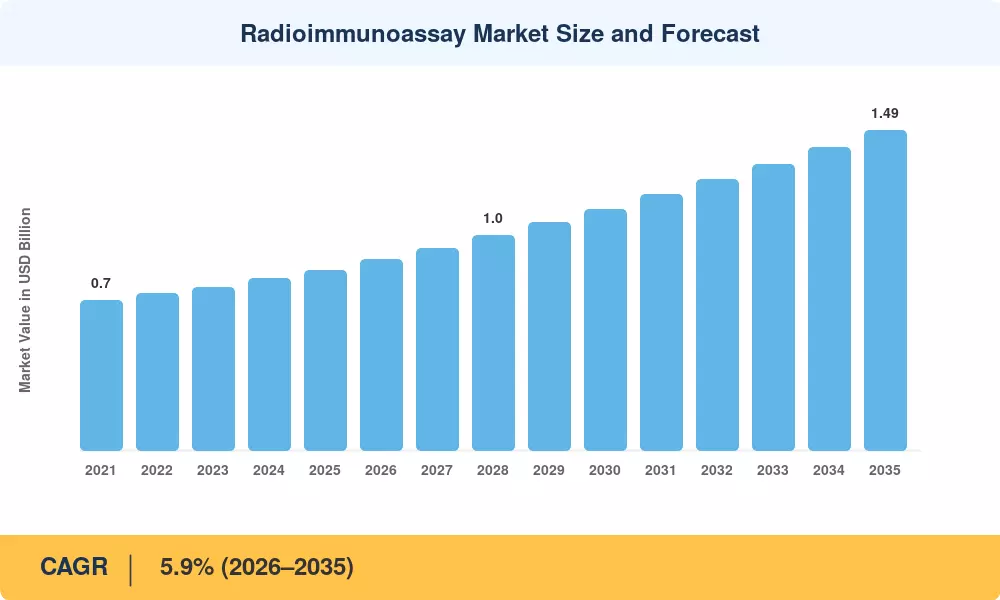
Radioimmunoassay Market to Surge from USD 0.84 Billion in 2025 to USD 1.49 Billion by 2035—By Rising Cancer and Chronic Disease Prevalence, Analyzer Automation
NY, CA, UNITED STATES, August 28, 2026 /EINPresswire.com/ — As per Market Research Future, the global Radioimmunoassay Market size is projected to reach USD 1.49 Billion by 2035 from USD 0.84 Billion in 2025, at a CAGR of 5.9% during the forecast period 2026–2035. The market value is expected to reach USD 0.89 Billion in 2026 as the first year of the forecast period.
The 5.9% CAGR—anchored by structural shifts in diagnostic medicine—is propelled by three converging forces: the rising global prevalence of cancer and chronic diseases, with WHO projections indicating cancer cases worldwide would increase from 20 million in 2024 to over 35 million annually by 2050, driving healthcare providers to increasingly adopt radioimmunoassay platforms for ultra-sensitive tumor marker detection and endocrine profiling; advancements in analyzer automation and digital signal processing, with next-generation platforms integrating robotic sample loading, barcode tracking, and cloud-based quality control dashboards that reduce technician hands-on time by up to 40% and manual error rates by an estimated 35%; and expanding government investment in diagnostic infrastructure across low- and middle-income countries, including India’s National Health Mission allocating INR 37,000 Crore for healthcare infrastructure and China’s 14th Five-Year Plan pledging to upgrade hospital laboratories at the county level in 2,800 counties.
Global diagnostic companies and health organizations are amplifying this momentum. Siemens Healthineers holds an estimated 12–15% revenue share with its IMMULITE analyzers and comprehensive reagent menus. DiaSorin commands approximately 10–13% share with its LIAISON platform and specialty immunoassay kits. Beckman Coulter has invested over USD 80 Million in platform digitization since 2022, targeting laboratories processing more than 500 samples per day. According to WHO data, cancer diagnoses alone exceeded 20 million new cases in 2024, while the U.S. National Institutes of Health allocated over USD 47 Billion to biomedical research in FY2024. These forces are creating the clinical infrastructure and testing demand on which the Radioimmunoassay Market depends.
Request A Free Sample:
https://www.marketresearchfuture.com/sample_request/26292
Key Market Trends & Growth Drivers
Rising Cancer and Chronic Disease Prevalence
The market is witnessing increasing demand driven by the global surge in chronic disease burden. According to World Health Organization projections, cancer cases worldwide would increase from 20 million in 2024 to over 35 million annually by 2050. Particularly for thyroglobulin, PSA, and CA-125 panels, where sensitivity thresholds below 0.1 ng/mL are therapeutically necessary, radioimmunoassay techniques remain essential for tumor marker detection. Disease burden is the most consistent growth driver for the radioimmunoassay market over the next ten years, as this epidemiological tailwind directly supports reagent consumption levels across hospital and reference laboratory networks. Siemens Healthineers continues advancing product development through next-generation analyzer platforms while strengthening strategic partnerships supporting oncology and endocrine testing research.
Analyzer Automation and Digital Upgrades
Innovations in analyzer technology are becoming a hallmark of the industry. Modern radioimmunoassay analyzers now incorporate robotic sample loading, barcode tracking, and cloud-based quality control dashboards that reduce manual error rates by an estimated 35%. Siemens Healthineers and Beckman Coulter have each invested over USD 80 Million in platform digitization since 2022, targeting laboratories processing more than 500 samples per day. These capital investments create a pull-through effect on proprietary reagent sales, reinforcing closed-system business models that benefit the Radioimmunoassay Market throughout the analyzer lifecycle. Automated sample handling reduces technician hands-on time by up to 40%, improving laboratory throughput and operational efficiency.
Stricter Bioanalytical Validation Mandates
The incorporation of tighter regulatory requirements into the industry is gaining traction. The FDA’s 2022 Bioanalytical Method Validation Guidance and the EMA’s updated ICH M10 guideline imposed tighter acceptance criteria for ligand-binding assays used in clinical pharmacology studies. Laboratories conducting regulated bioanalysis must now demonstrate parallelism, selectivity, and matrix-effect controls that favor validated radioimmunoassay kits over in-house developed methods. This regulatory tightening channels procurement budgets toward commercially validated platforms, benefiting established Radioimmunoassay Market vendors with robust regulatory dossiers. The EU’s In Vitro Diagnostic Regulation (IVDR), fully enforced since May 2022, has elevated performance evaluation requirements for commercial assay kits.
Emerging Economy Laboratory Expansion
The rising investment in diagnostic infrastructure across emerging economies is a primary driver. In 2024–2025, India’s National Health Mission allocated INR 37,000 Crore for healthcare infrastructure, including 150,000 new Health and Wellness Centers with basic diagnostic capabilities. China’s 14th Five-Year Plan pledged to upgrade hospital laboratories at the county level in 2,800 counties. These initiatives significantly increase the addressable radioimmunoassay market in Asia-Pacific by generating greenfield demand for assay platforms in areas where radioimmunoassay usage was previously restricted to tertiary care facilities. The market is projected to expand as healthcare systems in low- and middle-income countries modernize their laboratory capabilities.
Ask for Customization:
https://www.marketresearchfuture.com/ask_for_customize/26292
Market Segment Insights
BY PRODUCT TYPE
Reagents & Kits: Largest segment with 62% share in 2025, driven by recurring consumable demand from high-throughput laboratories. Proprietary closed-system architectures reinforce vendor lock-in and stabilize recurring revenue streams.
Analyzers: Fastest-growing segment at 6.4% CAGR, propelled by capital refresh cycles and automation upgrades across clinical diagnostic facilities. Winning an analyzer placement effectively secures 5–7 years of downstream reagent purchases.
Immunoradiometric Assay (IRMA): Positioned as a high-sensitivity alternative catering to specialized therapeutic drug monitoring and peptide hormone quantification needs.
Radiobinding Assay & Radioreceptor Assay: Smaller but significant segments, reflecting demand in research and pharmaceutical bioanalytical applications requiring precise ligand-receptor interaction measurement.
BY APPLICATION
Clinical Diagnostics: Largest segment generating USD 0.53 Billion in 2025, anchored by endocrine and oncology testing panels. Endocrinology panels account for the largest clinical volume, though oncology tumor marker panels represent the fastest-growing clinical application.
Research: Fastest-growing application at 6.7% CAGR, as academic institutions and biopharmaceutical companies invest in biomarker discovery programs requiring ultra-sensitive quantification of low-abundance analytes.
Oncology: Significant and expanding share, driven by rising cancer prevalence and the need for sensitive tumor marker detection in PSA, CA-125, AFP, and thyroglobulin panels.
Endocrinology, Infectious Disease, and Immunology: Smaller but steady segments, reflecting sustained demand for thyroid hormones, cortisol, insulin, reproductive hormones, and specialized infectious disease marker quantification.
BY END USER
Hospitals: Largest segment with 36% share in 2025, benefiting from integrated diagnostic service delivery and in-house nuclear medicine and clinical pathology laboratories.
Clinical Diagnostic Laboratories: Fastest-growing end-user channel at 6.2% CAGR, gaining traction as healthcare systems outsource specialized testing to achieve economies of scale.
Pharmaceutical Industries: Significant share at USD 0.15 Billion in 2025, driven by regulated bioanalytical studies requiring validated assay platforms with demonstrated sensitivity for low-abundance analytes.
Research Institutes and Other End Users: Smaller but steady share, reflecting academic and government research demand for specialized high-sensitivity kits in pharmacokinetic and biomarker validation studies.
BY DETECTION METHOD
Solid-Phase Radioimmunoassay: Dominant method, offering robust efficacy, ease of automation, and established preference among high-throughput clinical laboratories.
Liquid-Phase Radioimmunoassay: Significant method, positioning itself as a high-precision alternative for research and specialized clinical applications requiring maximum sensitivity.
Read Detailed Insights:
https://www.marketresearchfuture.com/reports/radioimmunoassay-market-26292
Regional Outlook
North America — Market Leader in Innovation
North America leads with 38% of global revenue in 2025, generating around USD 0.32 Billion. The region’s growth is driven by entrenched laboratory networks, robust reimbursement frameworks, and over 260,000 CLIA-certified laboratories in the United States alone. CMS reimbursement rates for radioimmunoassay-coded procedures remained stable through 2024, preserving the economic viability of isotope-based testing for specialty panels. The competitive landscape is characterized by continuous automation upgrades and strategic partnerships among leading diagnostic companies.
Europe — Second Largest Market
Europe holds approximately 28% of the global share in 2025, representing the second-largest regional market. The region benefits from concentrated pharmaceutical R&D activity in Germany, Switzerland, and the UK, where bioanalytical contract laboratories perform regulated studies requiring validated assay platforms. Regulatory bodies like the EMA have tightened bioanalytical method validation requirements under updated ICH M10 guidelines. Leading countries include Germany, France, and the United Kingdom, where major companies such as Siemens Healthineers and DiaSorin are heavily invested.
Asia-Pacific — Rapidly Growing Market Segment
The Asia-Pacific region is the fastest-growing market with a projected CAGR of 7.2%. The growth is driven by government-funded diagnostic modernization programs across China, India, and Southeast Asia. China’s National Health Commission directed provincial hospitals to upgrade clinical laboratory capabilities under the Healthy China 2030 initiative, while India’s Ayushman Bharat scheme is extending diagnostic coverage to over 500 million citizens. The competitive landscape is evolving with companies like Beckman Coulter and bioMérieux leading the charge.
South America — Emerging Opportunity
The South America region reached USD 0.06 Billion in 2025, driven by public health infrastructure investment and rising diagnostic awareness. Brazil’s Sistema Único de Saúde network generates consistent demand for endocrine and oncology assay services. Argentina’s CONICET research network sustains academic demand for specialized assay platforms. Countries like Brazil and Argentina are leading the way, with a growing presence of international diagnostic companies.
Middle East and Africa — Untapped Potential
The MEA region is advancing at a CAGR of 6.1%, driven by increasing awareness of advanced diagnostics, medical tourism, and rising healthcare investments. Saudi Arabia’s Vision 2030 initiative has channeled over USD 65 Billion into healthcare infrastructure development, including construction of 38 new hospitals and associated laboratory facilities. The UAE’s positioning as a medical tourism hub drives premium diagnostic service demand. Across sub-Saharan Africa, donor-funded laboratory programs managed by organizations like the Africa CDC and PEPFAR procure assay kits for HIV viral load monitoring and tuberculosis diagnostics.
Competitive Landscape and Recent Developments
The Radioimmunoassay market is characterized by intense competition and steady growth, driven by increasing prevalence of cancer and endocrine disorders worldwide. The global industry appears moderately consolidated, with several key players exerting significant influence.
KEY COMPANIES AND RECENT MILESTONES
Siemens Healthineers (DE): Holds an estimated 12–15% revenue share with its IMMULITE analyzers and comprehensive reagent menus. The company continues advancing next-generation analyzer platforms through sustained product innovation and strategic partnerships supporting high-throughput laboratory automation.
DiaSorin (IT) (June 2023): Introduced its new LIAISON B·R·A·H·M·S MR-proADM immunodiagnostic assay in all nations that recognize the CE Mark. Holds approximately 10–13% revenue share with its specialty immunoassay kits and niche analyte focus.
Beckman Coulter (US) (Danaher): Holds approximately 9–12% revenue share with its Access analyzers and clinical chemistry integration. Has invested over USD 80 Million in platform digitization since 2022, targeting laboratories processing more than 500 samples per day.
PerkinElmer / Revvity (US): Holds approximately 7–10% revenue share with its Wizard gamma counters and screening reagents. Positioned as a leader in neonatal and specialty screening segments.
Other Key Players: bioMérieux (FR), MP Biomedicals (US), IBL International / Tecan (CH), DRG International (US), Diasource ImmunoAssays (BE), Stratec Biomedical (DE).
Future Outlook: 2026–2035
The Radioimmunoassay Market is projected to reach USD 1.49 billion by 2035, growing at a CAGR of 5.9%, driven by increasing cancer prevalence, expanding diagnostic infrastructure, and advancements in analyzer automation.
New opportunities lie in:
Development of point-of-care and decentralized miniaturized gamma-counter systems for urgent care and rural health outposts
Companion diagnostic development partnerships with pharmaceutical sponsors for biomarker-driven patient stratification
Multiplex radioimmunoassay panels enabling simultaneous quantification of 4–8 analytes from a single sample aliquot
AI-driven automated quality control systems transforming quality assurance from reactive to predictive
Ultra-low-activity reagent formulations addressing green laboratory initiatives and radioactive waste reduction
Expansion into emerging markets with affordable, tropicalized kit formats with extended cold-chain stability
By 2035, the Radioimmunoassay Market is expected to achieve substantial growth and innovation, with competitive dynamics intensifying as automation and digital connectivity redefine how radioimmunoassay laboratories operate worldwide.
More Related Research Insights:
https://www.marketresearchfuture.com/reports/single-use-assemblies-market-21530
https://www.marketresearchfuture.com/reports/atopic-dermatitis-market-1610
https://www.marketresearchfuture.com/reports/stem-cell-banking-market-8441
https://www.marketresearchfuture.com/reports/gas-analyzers-market-23149
https://www.marketresearchfuture.com/reports/clinical-trial-support-services-market-22002
https://www.marketresearchfuture.com/reports/fibrotic-diseases-treatment-market-37026
https://www.marketresearchfuture.com/reports/teleradiology-market-11059
https://www.marketresearchfuture.com/reports/microneedle-patche-market-38683
https://www.marketresearchfuture.com/reports/dental-laboratories-market-9282
https://www.marketresearchfuture.com/reports/compounded-pharmacy-market-22115
Market Research Future
Market Research Future
+1 855-661-4441
email us here
Legal Disclaimer:
EIN Presswire provides this news content “as is” without warranty of any kind. We do not accept any responsibility or liability
for the accuracy, content, images, videos, licenses, completeness, legality, or reliability of the information contained in this
article. If you have any complaints or copyright issues related to this article, kindly contact the author above.

Media gallery